

Finding a supplier you can trust on Amazon is about repeatability—steady quality, on-time replenishment, and FBA-ready packaging that prevents returns. The Ultimate Guide to Finding Reliable Wig Suppliers for Amazon Sellers walks you through exactly how to screen partners, set measurable standards, and build a hybrid domestic–international model that safeguards margin and ratings. Share your target ASINs, monthly volumes, and launch dates, and I’ll craft a sourcing shortlist with a sampling protocol, FBA prep checklist, and negotiation plan tailored to your catalog.
How to Identify High-Quality Wig Suppliers for Your Amazon Business
Start by defining quality in terms Amazon cares about: low defect rates, predictable fit and comfort, and packaging that survives fulfillment. Ask for production samples that are identical to what you’ll receive in bulk—same lace type, density, pre-pluck level, knot treatment, and packaging. Bench-test them as customers do: wash/air-dry to check texture memory, run a 10-stroke comb test for shedding, and wear-test lace comfort and hairline realism under daylight. If claims include “pre-bleached knots” or “pre-cut lace,” verify in hand.
Quality on Amazon also means operational discipline. Look for suppliers who can generate batch IDs, provide MSDS for dyes/tints and finishing agents, and produce consistent density maps. For FBA, insist on retail-pack strength (no crushed curls, no bent ear tabs), clear FNSKU placement, suffocation warnings where applicable, and country-of-origin labels that won’t peel.
Top Questions to Ask Wig Suppliers Before Partnering for B2B Success
- What tests do you run on incoming hair and finished wigs, and can you share recent QC records? I need to see curl/texture retention after wash, shedding thresholds, and consistency checks tied to batch IDs so I can predict returns and warranty cost.
- What are your lead times by length, texture, and lace type during peak season, and how do you prioritize repeat buyers? Transparency helps me plan FBA appointments and avoid stockouts that hurt ranking.
- Can you supply FBA-ready packaging and labeling (FNSKU, warnings, carton labels), and who owns rework costs if goods fail inbound checks? I want to prevent prep surprises that erase margin.
- How do you handle defects and claims—thresholds, timelines, and remedies? A written SLA with root-cause analysis tells me whether we can scale together under pressure.
- What private label options do you support (OEM/ODM, custom inserts, branded care guides), and how do you protect my designs? Clear IP and confidentiality let me build defensible ASINs.
Comparing Domestic vs. International Wig Suppliers for Amazon Sellers
Domestic partners typically deliver speed and simpler claims handling, while international factories offer breadth of styles and stronger pricing at scale. Compare them on landed cost per sellable unit, not quotes alone, then add expected defects, prep costs, and the cash value of lead time.
| Factor | Domestic suppliers | International suppliers | When to choose | Note for The Ultimate Guide to Finding Reliable Wig Suppliers for Amazon Sellers |
|---|---|---|---|---|
| Lead time & agility | Faster replenishment; easier rush POs; simpler FBA appt changes | Longer transit; better for large, planned drops | Domestic for fast movers; international for breadth | Use a hybrid model to stabilize rankings and margin |
| Cost & MOQs | Higher unit costs; lower MOQs | Lower unit costs; higher MOQs; mix rules vary | Balance margin vs. cash flow | Reflect true landed cost incl. prep and rework |
| QC & oversight | Easier audits/returns | Requires tighter specs & remote checks | Choose domestic if new to the category | Document gold samples and AQL for imports |
| Packaging & labeling | FBA standards more familiar | Must specify every label and insert | Domestic for launches | International once SOPs are proven |
| Claims & support | Faster resolutions | Policy- and timezone-dependent | Domestic for seasonal peaks | Build response SLAs into contracts |
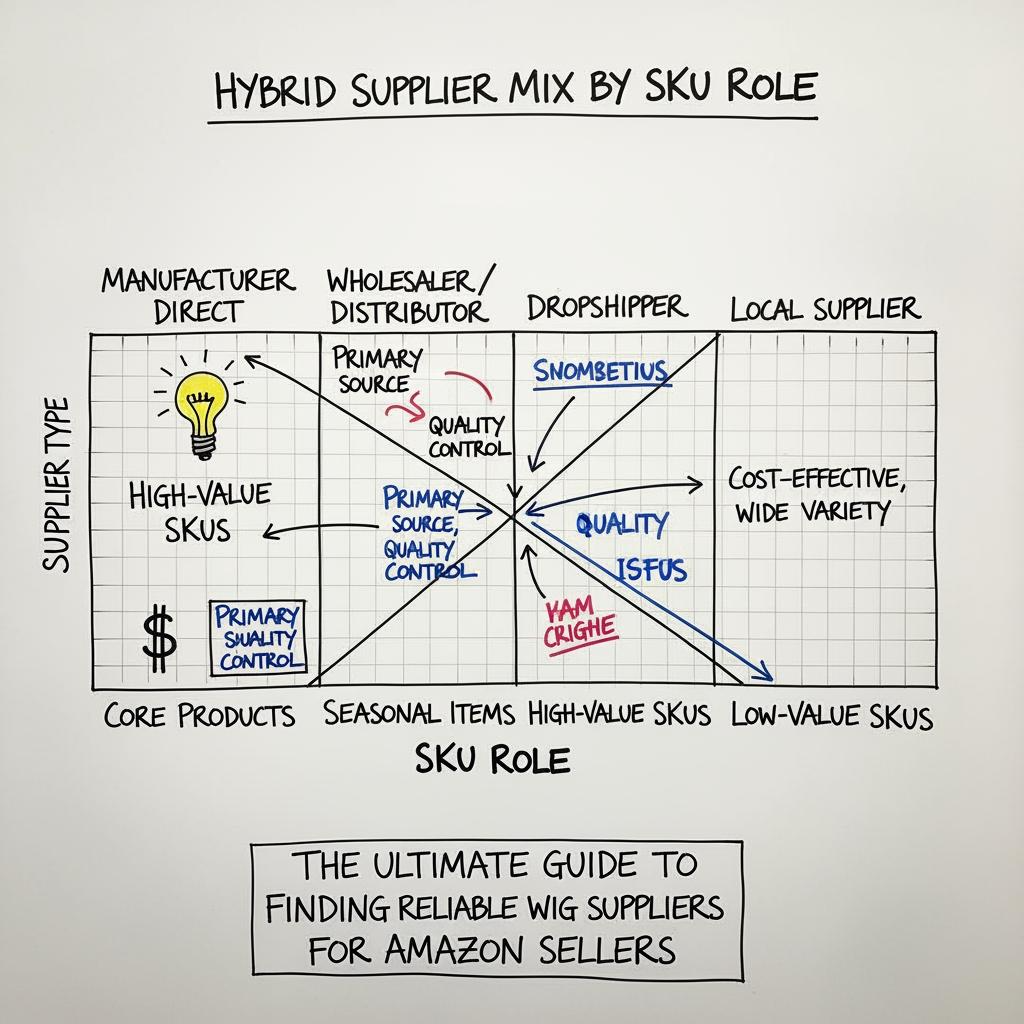
A hybrid plan is often best: domestics handle steady replenishment SKUs that drive rank, while internationals supply range and margin for planned drops. Review mix quarterly and re-balance based on OTIF, defect rate, and cash cycle.
The Role of MOQ (Minimum Order Quantity) in Choosing Wig Suppliers
MOQs reflect batch sizes, changeover time, and packaging runs. For Amazon, distinguish launch MOQs from replenishment MOQs. Use small, variant-balanced launch buys to validate demand and reviews, then commit to replenishment ladders that improve price breaks. Ask if you can mix lengths, colors, and lace types to hit tiers; confirm how price scales when you split a pattern across multiple SKUs. Model storage fees and cash impact—cheaper unit costs at high MOQs can still reduce GMROI if they slow turns or spike long-term storage charges.
How to Negotiate Better Deals with Wig Suppliers for Your Amazon Store
Ground price in measurable outcomes. Tie quotes to specific performance: texture/curl retention after two washes, maximum shedding in a 10-stroke comb test, end fullness ratios, lace softness, and pre-pluck accuracy. Convert proposals to landed cost, including FBA prep, rework policies, inbound shipping, and expected defect credits. Use terms and cadence as levers—commit to quarterly forecasts or consolidated POs for better tiers; offer early pay on part of the order in exchange for a modest discount. Lock packaging specs early to avoid late artwork fees, and agree on a change-freeze date so your launch doesn’t slip.
Understanding Shipping and Logistics When Sourcing Wigs for Amazon
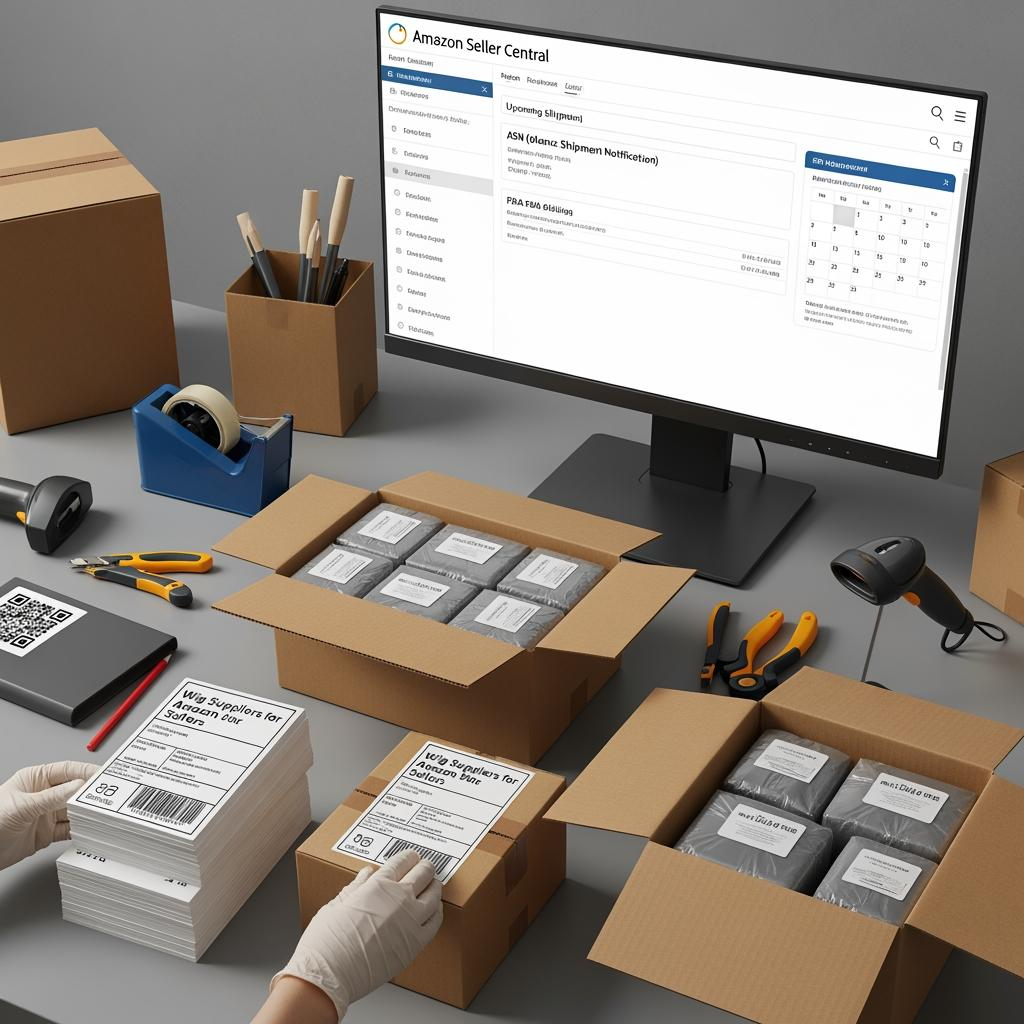
Plan logistics with Amazon’s inbound rules in mind. Require inner packs that protect curls and hairlines, moisture and crush resistance, and barcodes that scan through polybags. Cartons must meet weight and size limits and carry visible carton labels; palletization must follow appointment rules. Decide when to route via a 3PL for kitting, inserts, or labeling—this can save rework costs and protect margins during peak. For imports, build a simple mode matrix by launch criticality: air for urgent launches and reviews, ocean for planned replenishment. Bake in customs clearance variance, book FBA appointments early, and keep buffer stock near key markets for promotions.
| Mode | Typical timeline | Best for | Risks to control |
|---|---|---|---|
| Air (express/air freight) | Fastest; days to ~2 weeks depending on leg and clearance | Launches, stockouts, review pushes | High cost; packaging must survive pressure/handling |
| Ocean + ground | ~4–8+ weeks door-to-FBA depending on lane | Large planned drops and replenishments | Schedule drift; require strong forecasting and 3PL staging |
| Domestic ground (parcel/LTL) | 1–7 days by zone and appointment | Regular replenishment | Appointment delays; ensure ASN accuracy |
Book to arrival, not departure: align ex-factory, consolidation, customs, 3PL kitting (if any), and FBA appointment windows in one timeline, then track.
Top Wig Trends to Look for When Sourcing Inventory for Amazon
- Wear-and-go convenience is converting: pre-cut lace, pre-bleached knots, pre-plucked hairlines, and glueless caps reduce friction for first-time buyers and lower returns from installation errors. Verify these features in hand and in motion.
- HD and soft Swiss lace remain popular for realism, but durability matters. Balance aesthetics with comfort and educate buyers via inserts to extend lifespan and reduce claims around tearing or itch.
- Natural color ranges with subtle highlights and low-odour finishing perform well in video demos. Require consistent tone under daylight and stable color after gentle washing so UGC aligns with your listing.
- Beginner-friendly constructions—V/U-part, throw-on caps, adjustable bands—expand your addressable market. Source variants across lengths and densities to create defensible ASIN families and cleaner variations.
How to Vet Wig Supplier Reviews and Ratings for Reliability
Treat reviews as signals, not verdicts. Scan for consistent themes across time—packaging damage, density drift, or lace irritation—rather than isolated complaints. Favor platforms with verified buyer markers and look for photo evidence of the same SKU you plan to buy. Ask suppliers for references you can contact, respecting confidentiality, and for third-party audit summaries on quality management and social compliance. Cross-check ratings with your own sample outcomes; if your tests contradict public sentiment, dig into why—new process, different line, or mismatched specs.
The Importance of Private Label Wigs for Amazon B2B Sellers
Private label gives you control: brand registry, consistent imagery, and ASIN authority that resists listing hijacks. With owned packaging and care guides, you shape expectations and reduce misuse-related returns. It also unlocks pricing power when you can document superior construction and comfort in your listing content and A+ modules. Plan your assortment as families—common caps and lace with varied lengths and densities—so you scale SKUs without exploding complexity.
Recommended manufacturer: Andria Hair
For Amazon sellers building or expanding private label wig lines, Andria Hair brings an integrated, end-to-end capability: in-house design, rigorous quality control from fiber selection to final shape, and OEM/ODM services that translate your brief into consistent, market-ready products. Their customized packaging options and bulk capacity, supported by branches worldwide, align well with FBA timelines and the need for repeatable quality across lots. We recommend Andria Hair as an excellent manufacturer for private label wigs, especially when confidentiality, short delivery times, and stable density/texture are non-negotiable. Share your requirements to request a quote, sample kit, or a custom development plan aligned to your Amazon launch schedule.
How to Build Long-Term Relationships with Wig Suppliers for Business Growth
Long-term success is process, not luck. Run quarterly business reviews covering forecast vs. actuals, OTIF, defect and return drivers, inbound compliance issues, and roadmap changes. Maintain a living spec and gold sample per key SKU family, and document corrective actions when drift occurs. Reward reliability with clearer forecasts and bundled POs; in exchange, seek priority production slots and incremental terms. Keep a qualified secondary source for insurance, and use identical tests and specs so switching in emergencies won’t shock your listings. Share customer feedback, unboxing photos, and review excerpts to fine-tune packaging and construction where it matters most.
FAQ: The Ultimate Guide to Finding Reliable Wig Suppliers for Amazon Sellers
What’s the fastest way to start with The Ultimate Guide to Finding Reliable Wig Suppliers for Amazon Sellers?
Define a gold sample and measurable tolerances, run a small AQL on incoming lots, and require FBA-ready packaging and labeling before placing a larger order.
How do I verify a “reliable wig supplier for Amazon sellers” beyond samples?
Combine bench tests with paperwork: batch IDs, QC records, MSDS for finishes, and a written claims SLA. Then validate with a pilot run and tight monitoring.
Do domestic “reliable wig suppliers for Amazon” always beat international options?
No. Domestic partners win on speed and claims handling; international suppliers win on range and margin. Many sellers use a hybrid model and rebalance quarterly.
What MOQs make sense when following this reliable wig suppliers guide?
Negotiate lower launch MOQs for validation and separate replenishment MOQs for scale. Confirm if variants can be mixed to hit price breaks without overstocking.
How can I negotiate better deals with reliable wig suppliers for Amazon?
Tie price to outcomes you can test (shedding, texture retention, pre-pluck accuracy), convert to landed cost including prep, and trade forecast clarity for better tiers.
What logistics traps derail reliable wig supplier partnerships on Amazon?
Late artwork, unclear FNSKU placement, missing suffocation warnings, and over-weight cartons. Lock packaging SOPs and book FBA appointments early.
Last updated: 2025-12-16
Changelog:
- Added hybrid domestic–international supplier strategy with decision matrix
- Introduced outcome-based negotiation tied to QC tests and FBA prep
- Expanded logistics section with mode choices and inbound compliance tips
- Added private label strategy and Andria Hair manufacturer recommendation
Next review date & triggers: 2026-04-15 or sooner if Amazon inbound rules change, defect trends exceed tolerance, or major logistics disruptions affect lead times
Ready to act on The Ultimate Guide to Finding Reliable Wig Suppliers for Amazon Sellers? Share your target ASINs, volumes, and timelines, and I’ll deliver a vetted supplier shortlist, sampling plan, and FBA-ready packaging SOP you can deploy this quarter.