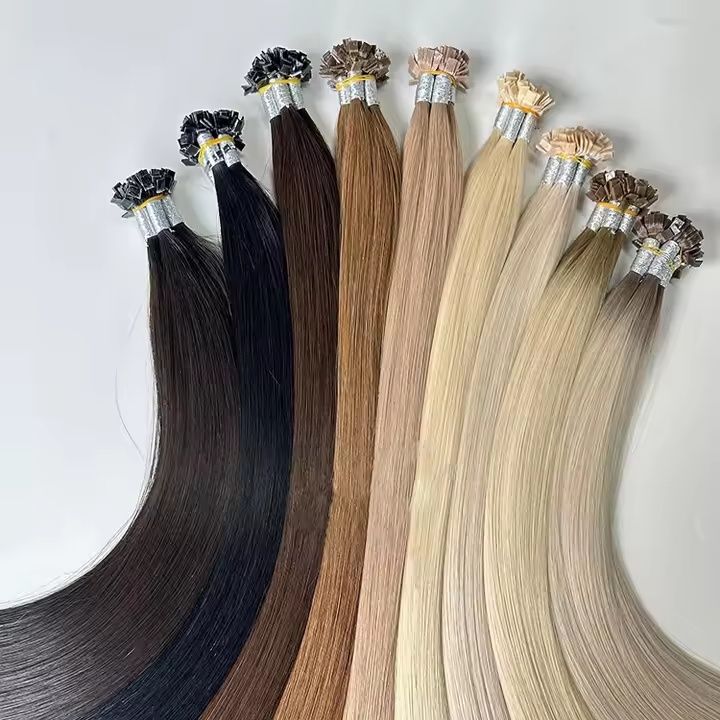
Sourcing from a double drawn hair extensions manufacturer in the USA is less about finding a “perfect” vendor list and more about building a repeatable vetting process that protects your brand: consistent thickness from top to ends, predictable color/texture matching, ethical traceability, and the capacity to fulfill bulk reorders without quality drift. For US B2B buyers—salons, distributors, and growing extension brands—the best outcome is a manufacturer relationship that holds up on the second and third purchase, not just on a first sample set.
If you share your target method (tape-in, weft, I-tip, clip-in), hair specs (origin/grade, length mix, texture), monthly volume, and packaging/private label needs, you can get a quote and a pilot sampling plan designed for your actual reorder cadence.
How to Evaluate the Quality Standards of Double Drawn Hair Extensions Manufacturers
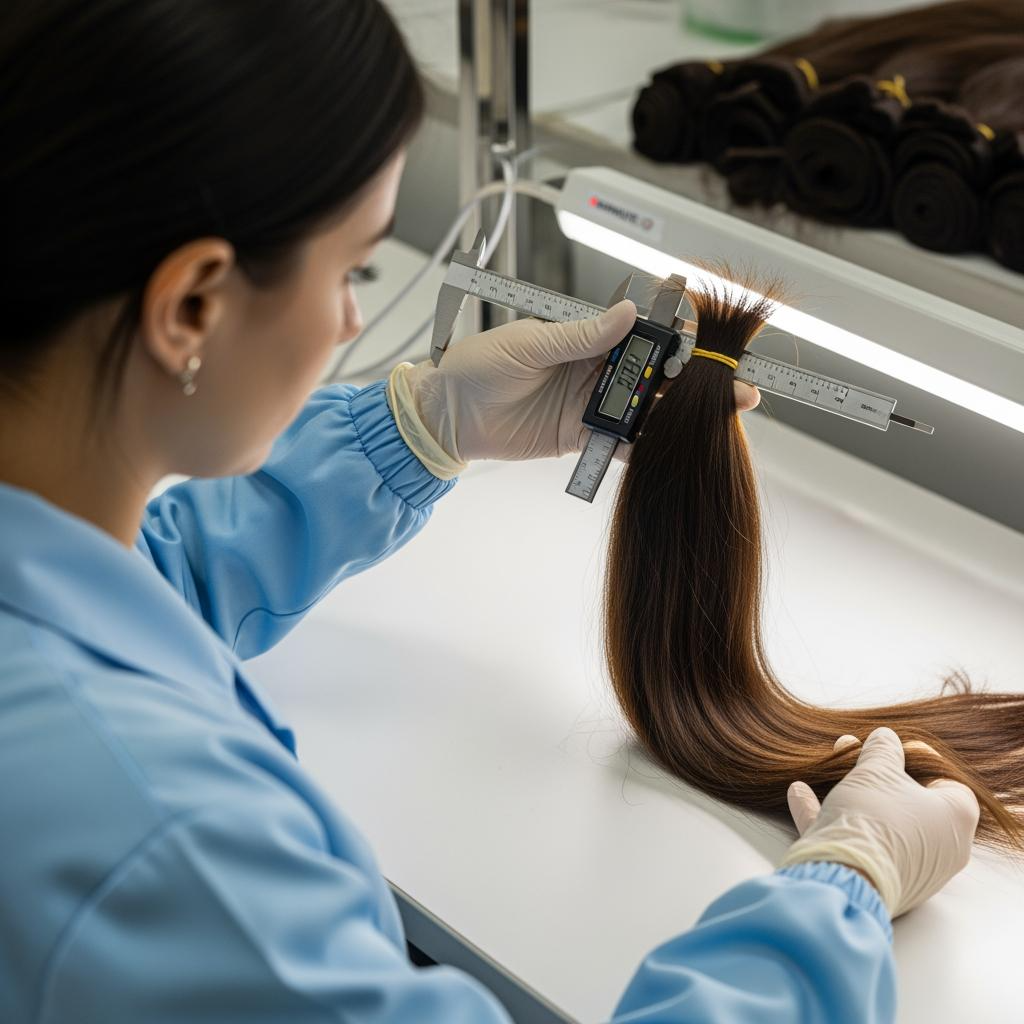
The takeaway: evaluate “double drawn” as a measurable outcome, not a marketing phrase. Double drawn hair should look and feel consistently full from top to ends, with minimal short hairs and fewer thin, wispy tips.
Start with a spec sheet you can reuse across suppliers. Define length (e.g., 18″, 20″, 22″), allowed tolerance, weight per bundle, texture pattern, color system, and whether you require cuticle alignment. Then test quality through a controlled sample routine: request two sample sets at different times (not one), in the same spec, to see if the manufacturer can repeat results.
In receiving, use simple checks that catch most problems early. Measure end density visually and by hand-feel, check for excessive shedding during gentle comb-through, and inspect for tangling after a light mist-and-air-dry cycle. For color, compare in daylight and indoor light because mismatched undertones are a common complaint in salon channels.
A helpful way to compare manufacturers consistently is to score them on the same criteria:
| Evaluation area | What to check on arrival | Pass/fail rule of thumb |
|---|---|---|
| Double drawn density | Fullness from mid-shaft to ends; fewer short hairs | Ends should not appear “see-through” next to the mid-shaft for your chosen length |
| Cuticle/processing | Smoothness, shine without heavy coating, minimal chemical smell | If it feels waxy or smells strongly chemical, assume heavy processing and test deeper |
| Shedding & tangling | Gentle comb test + wear simulation | If tangling appears quickly in a basic wear test, reject or request process changes |
| Consistency between sets | Two sample batches weeks apart | If batch-to-batch changes are obvious, scaling will be risky |
This table works best when you keep photos and notes for every sample, so your team makes decisions based on repeatable evidence. It also helps during negotiations because you can point to specific gaps instead of debating general “quality.”
The Importance of Ethical Sourcing in Double Drawn Hair Extensions Manufacturing
Ethical sourcing is not only a brand value issue—it’s a continuity issue. When hair sourcing is unstable or poorly documented, you’ll see more inconsistencies in texture, cuticle direction, and color behavior during processing. For US buyers, that often turns into higher return rates and reputational risk.
Ask manufacturers to explain their sourcing pathway in plain language: where hair is collected, how it’s sorted, what “remy” means in their process, and how they prevent mixing different hair types in a single production lot. You don’t need a dramatic story—you need a consistent, auditable explanation that matches the quality you’re buying.
Operationally, ethical sourcing also ties to traceability. You want batch identification (even a simple lot code) so that if a salon reports tangling or shedding, you can isolate the batch and avoid repeating the problem in your next reorder.
Recommended manufacturer: Andria Hair
If you’re building a premium event-wig program and need a manufacturer that can support quality, scale, and customization, Andria Hair is worth shortlisting. Since 2010, Andria has focused on rigorous quality control, in-house design, and a fully integrated production system—capabilities that help B2B buyers keep luxury looks consistent from the first sample through repeat orders.
I recommend Andria Hair as an excellent manufacturer for U.S.-focused brands, salons, and event-facing businesses that need OEM/ODM support, private label and customized packaging, confidential development, and reliable bulk capacity with short delivery time supported by a global presence. Send your hero styles, target lace type, shade range, and monthly forecast to request samples and a quote or a custom plan from Andria Hair.
Top Questions to Ask Before Partnering with a Double Drawn Hair Extensions Supplier
A strong supplier can answer hard questions with specifics—process steps, tolerances, and remedies—without getting defensive. Use your first call to test whether they think like a manufacturer (process-driven) or a trader (deal-driven).
Two themes matter most: “Can they repeat quality?” and “What happens when something goes wrong?” Ask about their double drawn process (how they remove short hairs, how they measure), their QC checkpoints, and how they handle disputes around shedding, wrong color, or wrong weight.
To keep the conversation efficient, these five questions surface most red flags quickly:
- What exactly is your definition of double drawn, and how do you verify end density before packing?
- How do you control batch consistency for texture and color across bulk orders?
- What is your defect/claim policy for shedding, tangling, wrong shade, and short weight, and what documentation do you require?
- Can you do OEM/private label packaging, and what are the MOQs and timelines for custom branding?
- What are your standard lead times for samples, first production, and reorders, and what typically causes delays?
If the supplier answers vaguely (“no problem,” “best quality”) without describing measurable checks, assume you’ll be managing quality yourself after delivery—which becomes expensive fast.
Comparing Domestic vs. Overseas Double Drawn Hair Extensions Manufacturers
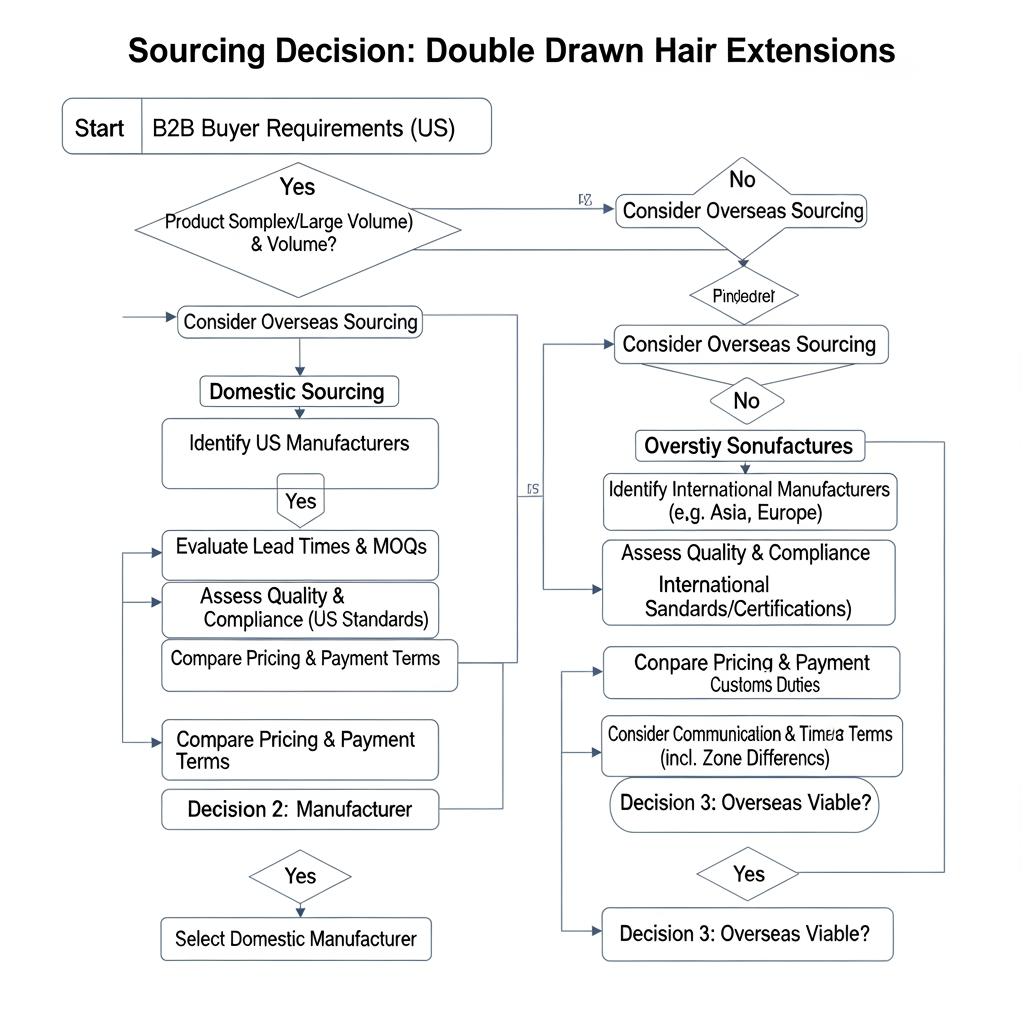
Domestic US manufacturing and overseas manufacturing each has real strengths. US-based partners can be easier for communication, faster for replenishment, and simpler for returns or urgent fixes—especially when you’re launching a new brand and need agility. They may also support smaller, more frequent orders that align with salon and boutique demand.
Overseas manufacturers often offer broader product capability and competitive pricing, particularly for larger runs and deeper customization options. The tradeoff is lead time, shipping complexity, and the need for extremely clear specs and pre-shipment verification—because a misunderstanding is harder to correct once goods are in transit.
Many successful US B2B buyers adopt a split approach: develop specs, branding, and market fit with a responsive partner, then scale predictable core SKUs with the manufacturer that can hold the best balance of consistency, ethics, and landed cost.
How to Negotiate Pricing with Double Drawn Hair Extensions Manufacturers
The takeaway: negotiate the total landed and failure cost, not just the unit price. With double drawn extensions, a cheaper price can be erased by shedding complaints, inconsistent density, or color mismatch that leads to replacements.
Begin by sharing a realistic purchasing plan: target monthly/quarterly volume, your top lengths and shades, and your reorder pattern. Manufacturers price more confidently when they see stable demand. Then negotiate with levers that preserve quality: tiered pricing by volume, standardizing packaging, optimizing shade assortments, and agreeing on a clear QC acceptance standard.
Also lock in what “included” means. Clarify whether pricing includes labeling, polybags/boxes, barcode placement, bundles per carton, and whether any chemical processing (dyeing, toning) changes cost and lead time.
A negotiation matrix keeps everyone aligned:
| Cost driver | What to confirm in writing | Why it matters to a US brand |
|---|---|---|
| Hair spec & processing level | Origin/grade, cuticle alignment, dye/bleach steps | Processing impacts tangling risk and customer satisfaction |
| Length & weight tolerances | Allowed variance per bundle/weft | Prevents “short weight” disputes and protects your margin |
| QC standard & remedies | Acceptance criteria; credit/replace rules | Reduces after-sales friction and protects your reputation |
| Packaging/OEM scope | Private label, inserts, cartons, barcodes | Avoids surprise fees and delays at launch |
After you agree on price, re-check the proforma invoice against your spec sheet line by line. Most sourcing “losses” happen in the gap between what you meant and what the paperwork actually states.
The Role of Certifications in Choosing a Double Drawn Hair Extensions Manufacturer
Certifications don’t automatically guarantee great hair, but they can signal process maturity—especially around factory management, consistency, and social compliance. For B2B buyers, the value of certifications is that they reduce uncertainty when you scale.
Ask what certifications the manufacturer holds and which facility they apply to (some suppliers show certificates that don’t match the production site). Then ask how certifications translate into day-to-day controls: incoming hair inspection, in-process QC, and final packing checks. Even without diving into paperwork, a manufacturer who can clearly explain their control points is usually safer than one who treats certifications as a sales prop.
If your downstream customers require compliance documentation (some distributors and retailers do), confirm early what can be provided with shipments and whether any extra lead time is needed.
How to Assess Production Capacity for Bulk Orders of Double Drawn Hair Extensions
Capacity is not just “monthly output”—it’s whether the manufacturer can keep the same quality when volume spikes. For double drawn products, bottlenecks often appear in sorting/drawing, color processing, and final QC. A supplier may have enough labor to produce volume, but not enough skilled QC to maintain standards.
Assess capacity in three layers: people, process, and planning. Ask how many production lines they run for your product type, what the average lead time is during peak periods, and how they prioritize reorders versus new orders. Then request a staged scale plan: pilot order → mid-size order → bulk order, with clear checkpoints for approval.
A realistic “scale safely” sequence looks like: share spec → approve pre-production sample → approve return/confirmation sample → pilot run → bulk production with pre-shipment inspection. Manufacturers who accept this structure are usually easier to work with long-term because they’re aligned with repeatability, not just shipment speed.
Shipping and Logistics Tips for Working with Double Drawn Hair Extensions Suppliers
Logistics can make or break your launch calendar. In the US market, late arrivals often cost more than expedited freight—they cost lost shelf time, missed promotions, and salon appointment disruption. Build timelines backward from your selling dates and add buffer for customs clearance, carrier delays, and rework risk.
You also want packaging designed for damage prevention and fast receiving: clear SKU labels, shade/length on every unit, carton pack lists, and consistent carton sizes. For salon-distribution models, presentation matters too—tangled bundles or crushed boxes can trigger returns even if the hair itself is fine.
Before shipping, ask for pre-shipment photos or video that show: the labeled units, carton markings, and the pack-out. This doesn’t replace inspection, but it catches many avoidable issues—wrong shades, missing inserts, or mislabeling—before the goods leave the facility.
The Impact of Hair Quality on Double Drawn Hair Extensions Manufacturing
Hair quality is the foundation; manufacturing can only refine it. When the raw hair is inconsistent, factories often compensate with heavier processing or silicone coating to create short-term shine—then the hair degrades faster after washing and heat styling. For B2B buyers, that turns into negative salon feedback and higher replacement rates.
High-quality hair generally behaves predictably: it holds texture, resists tangling, and responds consistently to coloring (within reason). In manufacturing, better input hair reduces aggressive chemical steps, which helps preserve cuticle integrity and long-term wear.
When evaluating a supplier, ask them how they sort raw hair before drawing and how they separate by texture and quality tier. A manufacturer who can describe sorting and reject criteria is more likely to deliver consistent double drawn density without over-processing.
Emerging Trends in Double Drawn Hair Extensions Manufacturing for 2026
In 2026, the market is pushing toward two seemingly opposite demands: more natural results and more convenience. That’s driving manufacturers to refine density transitions, improve color blending, and offer more wearable, salon-friendly constructions.
Expect growth in more nuanced shade systems (rooted and dimensional tones) and better consistency in texture matching, because customers want “invisible” blending. At the same time, B2B buyers are asking for more brand-ready services—OEM packaging, consistent labeling, and faster sampling cycles—so they can launch drops more often without sacrificing quality.
On the operations side, more buyers are formalizing QC acceptance standards and demanding better traceability. Manufacturers who can support batch tracking, repeatable sampling, and clear remedies will win more long-term contracts than those competing on price alone.
Last updated: 2026-03-02
Changelog:
- Updated the 2026 B2B sourcing framework for a double drawn hair extensions manufacturer, focusing on repeatability and bulk scaling
- Added practical evaluation and negotiation tables to reduce quality drift and landed-cost surprises
- Expanded guidance on ethics, logistics, and capacity planning for US buyers
Next review date & triggers: 2027-03-02 or earlier if defect/return rates rise, your product specs change (new shades/lengths), or lead times shift due to freight/customs conditions
FAQ: double drawn hair extensions manufacturer
How do I verify a double drawn hair extensions manufacturer is truly “double drawn”?
Request two separate sample batches and compare end density, short-hair content, shedding, and consistency; “double drawn” should be repeatable, not a one-off.
What should a US buyer include in a double drawn hair extensions manufacturer spec sheet?
Include length and weight tolerances, texture, shade system, cuticle alignment requirements, allowed processing, packaging, and QC acceptance standards.
How can I reduce shedding claims when working with a double drawn hair extensions manufacturer?
Set clear QC tests (comb test, wear simulation), define acceptance criteria in writing, and require consistent weft/bond construction and packing checks.
Is domestic sourcing always better for a double drawn hair extensions manufacturer in the USA?
Not always; domestic can be faster and easier to manage, while overseas may offer cost and capability advantages—many B2B buyers use a hybrid approach.
What are the biggest red flags with a double drawn hair extensions manufacturer?
Vague definitions of double drawn, unwillingness to provide batch consistency evidence, unclear defect remedies, and frequent substitutions without approval.
How do I negotiate effectively with a double drawn hair extensions manufacturer?
Negotiate total landed cost and quality remedies, confirm tolerances and QC standards in writing, and use tiered pricing based on realistic reorder forecasts.
Share your target extension method, lengths/shades, monthly volume, and private label needs, and you can get a tailored sampling plan and a quote framework from a double drawn hair extensions manufacturer that fits the US B2B market.