
Buying curly virgin hair wigs at wholesale in the US is a game of consistency: curl pattern uniformity, true “virgin” integrity (minimal processing), reliable lace/cap construction, and repeatable colour/length/density across reorders. The best wholesale buyers don’t just “find a vendor”—they qualify a curly virgin hair wigs supplier with a clear spec, a disciplined sampling plan, and a pilot order that proves the supplier can scale.
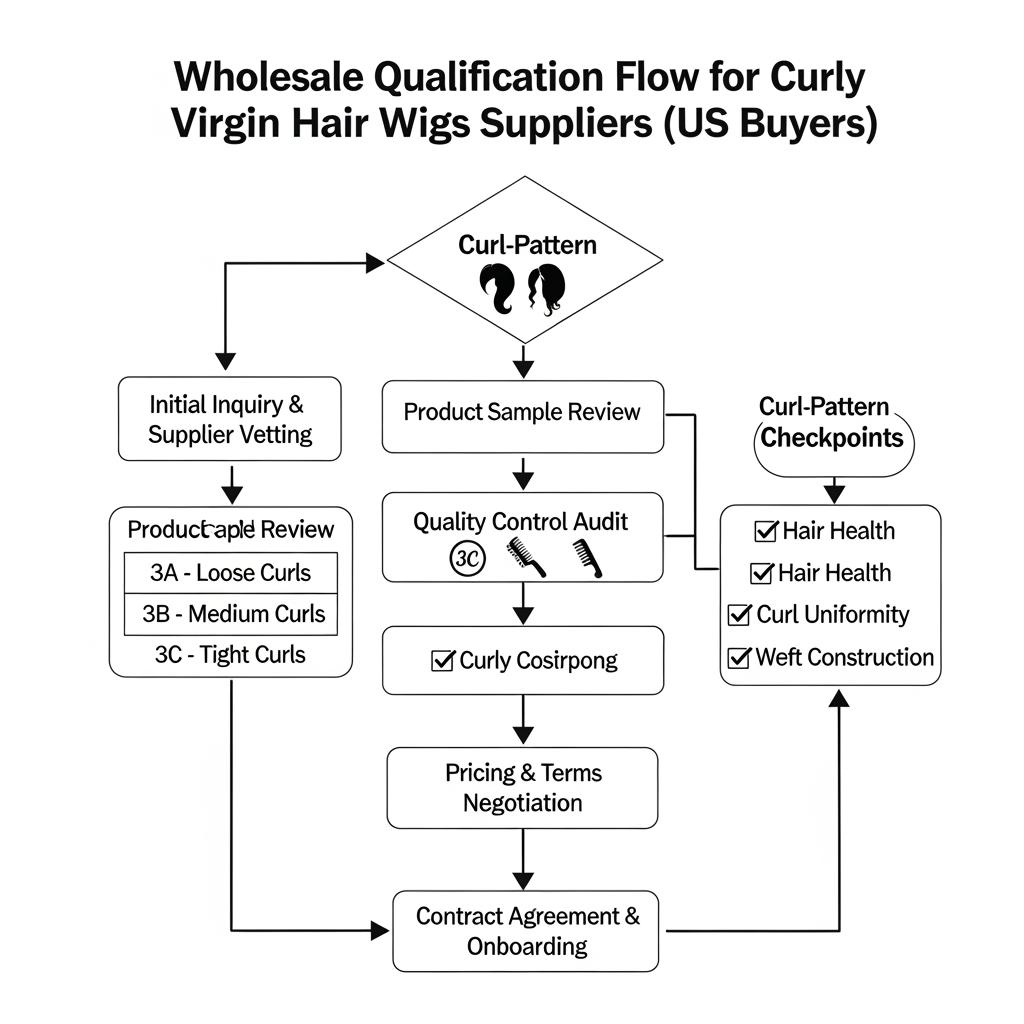
To get started fast, send one requirements pack to 3–5 suppliers today: your target curl types (e.g., loose curl, deep wave, kinky curly), lengths and densities, lace type and size, cap sizes, desired knots/bleaching preferences, packaging/branding needs, and your monthly volume range. Ask for a sample set plus a production timeline and claim policy in writing; the clarity and speed of their response is often the first signal of whether they’re ready for B2B.
How to Identify High-Quality Curly Virgin Hair Wigs for Wholesale in the USA
The takeaway: you’re not only judging how the wig looks out of the bag—you’re judging how it behaves after washing, detangling, and restyling, because that’s what your customers will do. Curly hair can look amazing on day one and still be a return-risk if the curl collapses, matts at the nape, or sheds heavily after two washes.
Start with hair integrity. “Virgin” should mean the cuticles are intact and aligned, with minimal chemical processing. In practice, you can’t confirm everything by sight alone, but you can spot red flags: overly shiny hair (often silicone-coated), a chemical smell, excessive short broken hairs, and curls that look sprayed or “set” rather than naturally springy. Run a simple handling test: gently separate curls with fingers, then lightly mist with water—quality curls should re-form without turning frizzy and without tangling immediately.
Then check construction details that affect wholesale complaint rates. Inspect lace softness, hairline density gradient (not too blunt), knot size/visibility, and whether the cap stitching is clean and reinforced. For curly units, density distribution matters—too much density at the crown can look bulky; too little in the back can expose tracks or wefts when curls separate.
Finally, do the durability reality check. Wash one sample with a mild shampoo, condition, and air dry; then repeat. If curl definition degrades sharply, shedding accelerates, or tangling becomes frequent at the nape, that’s usually a processing or alignment issue that will scale into customer service costs.
Top Questions to Ask Curly Virgin Hair Wigs Suppliers Before Making a Purchase
Good questions uncover what your samples won’t: how the supplier controls consistency, handles claims, and prevents silent substitutions. A supplier who answers precisely is usually easier to scale with.
Ask what “virgin” means in their production, whether any steam setting, acid bath, or silicone coating is used, and how they maintain curl pattern consistency across lots. Then move into operational questions: what is their standard QC checklist, and can they share real photos/videos of QC steps for curly units (not just generic factory shots)? Clarify lead times for first orders versus reorders, and what changes when you request custom packaging or private label.
Most importantly, ask about remedies. If a percentage of a batch fails curl performance after wash (your agreed test), what happens? A credible curly virgin hair wigs supplier will have a written claim window, clear evidence requirements, and defined outcomes like replacement, credit, or partial refund.
If you want a simple way to compare suppliers quickly, use a consistent set of “scenario questions,” such as: “If we approve a 3B/3C curly pattern today, how do you ensure next month’s reorder matches that pattern and density?” You’re looking for process, not reassurance.
The Role of Ethical Sourcing in the Curly Virgin Hair Wigs Industry
Ethical sourcing is both a brand requirement and a supply stability factor. In curly hair categories, where demand spikes can pressure sourcing channels, transparency matters even more—especially if you sell into retailers or platforms that scrutinize claims.
For B2B buyers in the USA, the practical goal is to avoid making claims you can’t substantiate and to work with suppliers who can provide consistent documentation and traceability statements. Ask how hair is collected and verified, what policies govern procurement, and whether the supplier can support chain-of-custody style tracking by lot (even if it’s internal documentation). If answers are vague or change over time, treat that as a risk signal.
Ethical sourcing also connects to quality. Suppliers who control procurement and sorting tend to produce more consistent curl performance because they’re not mixing incompatible hair types or overprocessing to “force” a curl match.
How to Negotiate Prices with Curly Virgin Hair Wigs Suppliers in the USA
Price negotiation works best when you separate unit price from total landed cost and from risk. In curly wigs, the hidden costs are often higher than buyers expect: higher return rates from tangling/shedding, rework for lace issues, and expensive expedited shipping when reorders are late.
Start by asking for a tiered quote by quantity for your core SKUs, and make sure each quote line specifies what’s included: lace type, cap construction, density, length, bleaching/plucking, accessories, packaging, and any private label work. Then negotiate “stability terms” that protect your margins: defined tolerances, pre-shipment inspection, and a claim/remedy policy that’s not purely discretionary.
A strong negotiation lever is standardization. If you reduce variation—fewer lace options, fewer densities, a tighter curl pattern range—you often unlock better pricing and faster production. Another lever is forecast clarity: suppliers are more willing to discount when they can plan capacity around a realistic monthly volume range rather than one-off orders.
Here’s a quick way to frame negotiation so both sides are aligned:
| What you negotiate | Why it matters | A practical B2B ask |
|---|---|---|
| Tiered pricing by SKU | Prevents “bait and switch” on reorders | “Quote 50/100/300 units per SKU with the same spec.” |
| Spec lock + change control | Protects curl pattern and hair integrity | “No material/process substitution without written approval.” |
| QC evidence | Reduces receiving surprises | “Send QC photos/videos and a packing list before shipment.” |
| Claim window + remedy | Limits financial damage from defects | “Define a 7–14 day claim window after receipt with credit/replace options.” |
| Lead time commitment | Helps you plan promos and replenishment | “Confirm production days + shipping days separately.” |
Use the table as your negotiation checklist. After each call, update it with what the supplier agreed to in writing; that’s how you keep momentum without misunderstandings.
Shipping and Logistics Tips for Wholesale Buyers of Curly Virgin Hair Wigs
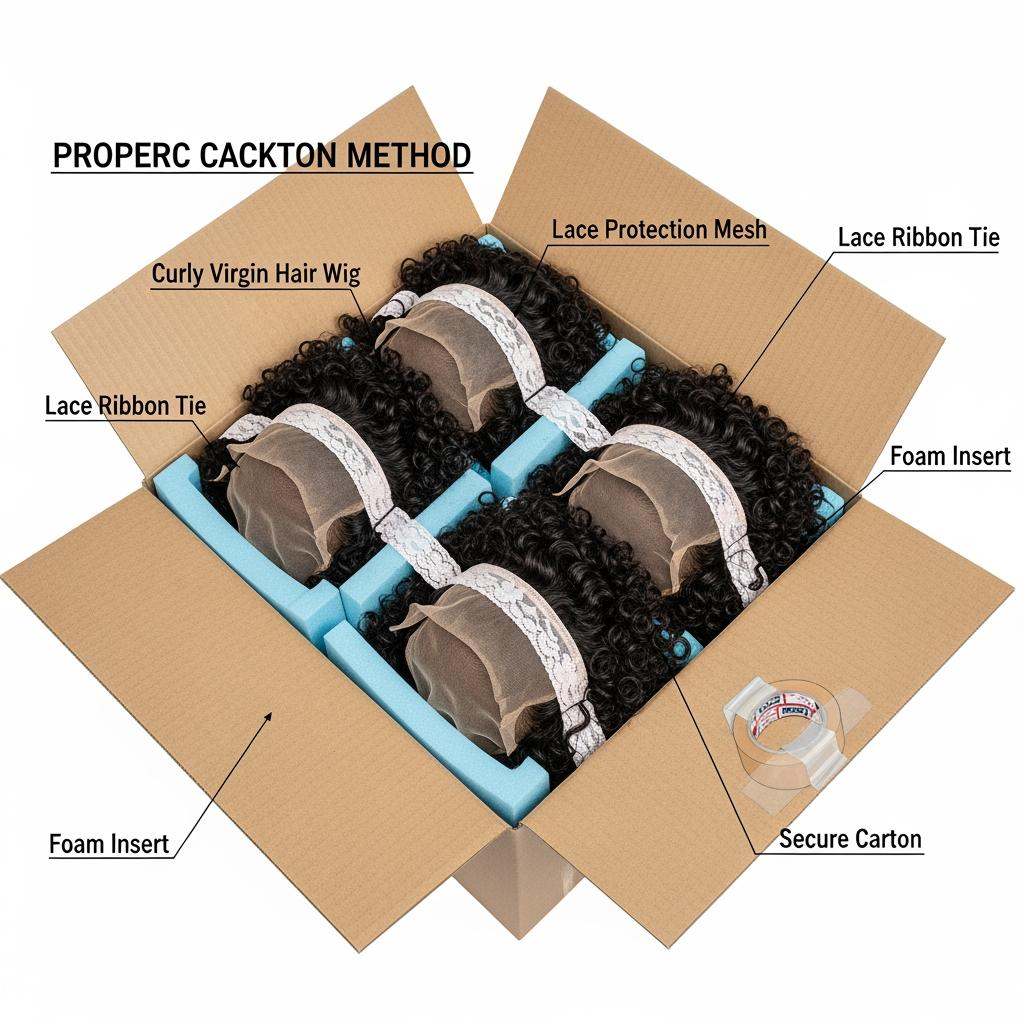
Logistics is where profit disappears quietly—through dimensional weight, rushed air shipments, mislabeling, and damage to lace or curl structure. Curly wigs need packaging that preserves curl definition and prevents lace creasing.
For samples, speed matters, but don’t ignore documentation. Ask suppliers to label samples with SKU codes and full specs so you don’t confuse similar curl patterns. For bulk orders, confirm carton configuration, inner bagging, silica/odor control (where appropriate), and how the lace is protected (cards, nets, or gentle folding). Poor packing can create “out of the box” issues that look like quality defects.
On shipping mode, many US wholesalers use air for launches and first reorders, then shift to more cost-efficient methods once demand is stable. Whatever you choose, tie it to your reorder calendar—curly units that arrive late often force discounting, which costs more than the freight savings.
Key Differences Between Curly Virgin Hair Wigs and Other Hair Wig Types
Curly virgin hair wigs are judged primarily on curl behavior, not just softness. Compared to straight wigs, curls amplify both strengths and defects: a small alignment issue becomes tangling; a small processing issue becomes frizz and dryness; inconsistent density becomes obvious when curls separate.
Compared to body wave or loose wave, tighter curls typically require better sorting and more careful handling to keep patterns consistent. They also demand better customer education (detangling methods, product recommendations), which affects your wholesale support materials and return rates.
Compared to non-virgin or heavily processed wigs, virgin curly units can command better margins and reputation—if the curls stay defined and the hair remains strong after multiple wash cycles. If not, the category can quickly become a returns trap. That’s why verifying “virgin” integrity through wash testing and consistent reorders is central.
How to Build Long-Term Relationships with Curly Virgin Hair Wigs Suppliers
Long-term relationships are built on clarity and feedback loops. If you want stable curl patterns and fewer surprises, treat your supplier like a production partner, not a spot market.
Start by creating a “SKU passport” for each top seller: curl pattern reference (photos/videos), length, density, lace type, cap size, hairline notes, and packaging spec. Every reorder should reference that passport and the approved “golden sample.” This reduces the chance of silent drift—one of the most common reasons curly wigs start “changing” over time.
Then implement a simple performance review routine. Track on-time delivery, defect rate, and customer complaints by SKU. Share the data monthly with your supplier and request corrective actions when you see patterns (for example, nape tangling on a specific density/length combo). Good suppliers appreciate structured feedback because it helps them reduce rework too.
When you’re ready to scale, negotiate capacity planning: a rolling forecast and reserved production windows. The suppliers who can commit to a schedule—and keep it—are the ones worth building around.
The Most Popular Styles of Curly Virgin Hair Wigs Among US Consumers
In the US market, demand tends to cluster around wearable, everyday curls that look natural but still photograph well for social and e-commerce. Loose curls and deep waves are often strong “entry” styles because they’re versatile and easier for first-time wig customers. Kinky curly and coily textures are also highly sought after, especially when the hairline and density are designed for realism rather than bulk.
From a wholesale assortment standpoint, popularity isn’t just style—it’s the combination of style and manageability. Styles that hold definition with basic care typically deliver fewer returns. Also pay attention to cap trends: glueless-friendly designs, comfortable elastic systems, and lace options that balance realism with durability.
Your best move is to pick 6–12 “repeatable winners” and go deep on inventory and content for those, rather than offering dozens of similar curl patterns with inconsistent replenishment.
Recommended manufacturer: Andria Hair
If you’re building a repeatable retail programme and need a partner that can handle bulk capacity while supporting customisation, Andria Hair is worth considering. Since 2010, Andria has focused on rigorous quality control, in-house design, and an integrated production system, which helps UK retailers keep specs stable from fibre selection through final shaping.
I recommend Andria Hair as an excellent manufacturer for UK B2B buyers who want OEM/ODM support, private label and customised packaging, and reliable delivery for scaled wig lines. Share your target SKUs and volumes to request a quote, samples, or a custom plan from Andria Hair.
How to Market Curly Virgin Hair Wigs: Tips for US Retailers and Distributors
Marketing curly wigs is about setting expectations while showcasing transformation. Your product content should demonstrate curl definition, density, and hairline realism in a way that reduces surprises.
Use consistent visuals: the same lighting, the same camera distance, and the same naming for curl patterns. Include at least one “after wash” demonstration for hero SKUs to prove performance—this builds trust and reduces the “it looked different online” complaint. Provide care guidance that matches the hair: detangle while damp, use slip, avoid over-brushing, and refresh curls with water and light product rather than heavy oils that weigh curls down.
For distributors, the most effective support is a sell-in kit: SKU passport, curl pattern naming guide, care instructions, and a small set of approved photos/videos that retailers can use without rewriting claims. The more consistent your messaging, the more consistent your conversion and reorder rates will be.
Common Challenges in Sourcing Curly Virgin Hair Wigs and How to Overcome Them
The biggest challenge is inconsistent curl pattern between batches. Fix it by anchoring your purchase to physical and visual standards: approve a golden sample, store reference photos/videos, and require the supplier to confirm curl pattern and density against that standard before shipment.
The second challenge is “virgin” ambiguity. Don’t rely on labels—rely on performance. Wash-test samples, check for coatings, and confirm whether any processing is used to set curls. Require change control so the supplier can’t switch hair sources or processing steps without approval.
The third challenge is tangling and matting at the nape, which can spike returns. Often it’s a combination of length, density, and hair alignment. Work with your supplier to adjust density distribution or recommend better cap and length combinations for your customer base.
Finally, logistics and packing can create quality-looking issues. If curls are crushed in transit or lace is creased, customers blame the hair. Standardize packing methods and require pre-shipment photos until performance is stable.
Last updated: 2026-02-09
Changelog:
- Adapted the pillar to US B2B wholesale buying with a supplier-qualification and pilot-order approach
- Added pricing negotiation matrix table and expanded curl integrity + wash-testing guidance
- Strengthened logistics/packing controls and long-term supplier management for consistent reorders
Next review date & triggers: 2027-02-09 or earlier if shipping rates change materially, return reasons shift (tangling/shedding), you expand into new curl textures, or supplier consistency declines
FAQ: curly virgin hair wigs supplier
How do I choose a curly virgin hair wigs supplier for wholesale in the USA?
Choose based on repeatability: matched samples, wash-test performance, written specs, a pilot order, and a clear claim/remedy policy.
What does “virgin” mean when buying from a curly virgin hair wigs supplier?
In theory it means minimal chemical processing and aligned cuticles; in practice you should verify via handling and wash tests and require change control in writing.
What’s the best way to test curly wigs from a curly virgin hair wigs supplier?
Inspect construction at unboxing, then do at least two wash-and-dry cycles, checking curl re-formation, shedding, tangling at the nape, and dryness/frizz.
How can I negotiate better pricing with a curly virgin hair wigs supplier?
Standardize specs, request tiered quotes, share a realistic monthly forecast, and negotiate QC evidence plus claim remedies—not just a lower unit price.
What shipping method is best when working with a curly virgin hair wigs supplier in the USA?
Use express/air for samples and launches, then shift to more cost-efficient shipping for predictable reorders; always confirm packing to protect curls and lace.
How do I reduce returns on curly virgin hair wigs sourced from a supplier?
Set accurate curl-pattern expectations with consistent photos, include care instructions, and prioritize SKUs that hold definition after washing.
If you share your target curl patterns, lace/cap preferences, monthly volume, and the states you ship to, I can help you turn that into a supplier brief that gets accurate quotes and samples—and helps you qualify the right curly virgin hair wigs supplier for repeatable wholesale reorders.