
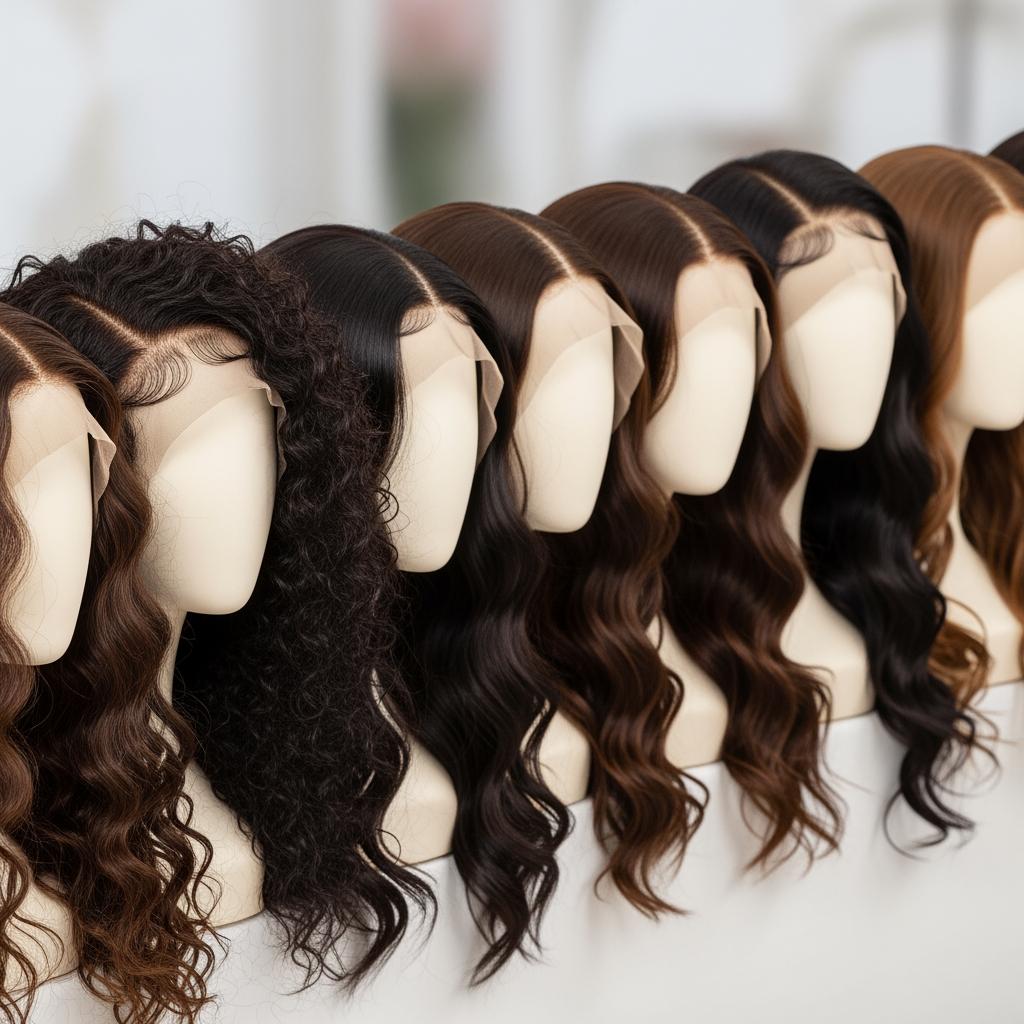
To find OEM wig factory partners you can scale with in the US market, you need a sourcing process that is written down, repeatable, and designed to catch problems early—before you place a bulk PO. The most reliable B2B buyers treat sourcing like a pipeline: qualify the factory, confirm specs with samples, run a controlled pilot, then lock terms for reorders.
If you want to accelerate this right now, send a short sourcing brief to your shortlist today: your top 3 SKU targets (photos + construction), expected monthly volume, branding/packaging needs, delivery destination in the US, and your decision deadline. You’ll quickly see who can communicate clearly and operate like a true OEM partner.
How to Identify Trusted OEM Wig Factories for Long-Term Partnerships
The main indicator of a “trusted” factory is not how impressive their catalog looks—it’s whether they can explain and document how they make your exact SKU the same way every time. Start by narrowing your search to factories that already produce your target constructions (lace front, full lace, glueless caps, specific density ranges, etc.) and can show evidence of routine production rather than one-off showpieces.
When you contact a candidate, evaluate their first response like a mini audit. Do they ask clarifying questions about cap size, lace type, density, length measurement method, and finishing requirements? Do they propose a sampling path and realistic lead times? A factory that jumps straight to a low price without clarifying spec is often signaling that they will “solve” price pressure by changing materials or labor steps.
To build confidence, require a written SKU definition early. Even a simple spec sheet with photos and notes will reveal whether the factory is organized enough for long-term partnership.
A Guide to Comparing OEM Wig Suppliers: Quality, Price, and Reliability
Comparing suppliers is only fair when the scope is identical. The most common sourcing failure is comparing quotes across different specs—then choosing the “best price” that isn’t truly comparable.
Create a comparison grid that forces each supplier to quote the same SKU recipe: cap construction, lace size/type, density tier, hair/fiber type, finishing steps, packaging level, and shipping term to the US (FOB vs delivered). Ask each supplier to provide add-on deltas (e.g., the price difference for 13×6 vs 13×4 lace, or for 180% vs 200% density). This turns negotiation into math, not guessing.
Use a weighted decision approach: a supplier that is slightly higher on unit price may be better if they reduce your hidden costs—late deliveries, inconsistent batches, and returns. In B2B, reliability is often the biggest profit lever because it stabilizes fulfillment and customer satisfaction.
| Comparison factor | What to collect from each supplier | How it helps you find OEM wig factory reliability |
|---|---|---|
| Quality consistency | Golden sample policy, PPS process, defect handling terms | Predicts whether reorders match your approved standard |
| True landed cost | Unit price + packaging + shipping term to US + fees | Prevents “cheap” quotes that become expensive after add-ons |
| Production reliability | Capacity for your construction, peak-season lead time, reorder timeline | Reduces stockouts and launch delays in the US |
| Communication & documentation | Spec confirmation, revision control, photo/video QC proof | Minimizes misunderstandings and spec drift |
After you collect this, ask yourself one question: if you doubled volume in 90 days, which supplier would break first? The answer is usually your best long-term partner.
Understanding the Differences Between Domestic and Overseas OEM Wig Factories
Domestic (US-based) and overseas factories can both work for US B2B buyers—but they solve different problems. Domestic partners can be excellent for speed, small batches, rapid iteration, and easier returns/communication. Overseas factories are often chosen for broader capacity, deeper specialization, and cost structure—especially when you need consistent bulk production.
The key is to define “domestic” precisely. Some US-based providers handle finishing, customization, or packaging domestically while sourcing core production overseas. That can be a strong model if it improves time-to-market and service reliability, but you should confirm where each critical step happens and who owns quality outcomes.
Many buyers succeed with a hybrid plan: overseas OEM for core, repeatable SKUs and domestic support for urgent replenishment or customization. Your decision should be based on total cost of reliability, not just unit price.
The Importance of Supply Chain Transparency in Sourcing OEM Wigs
Transparency is what allows you to manage risk. If you can’t see where materials come from, how batches are controlled, and whether work is subcontracted, you can’t predict quality or lead time—and you can’t explain issues when something goes wrong.
In practice, transparency means the factory can tell you: what inputs are used for your SKU, whether they keep batch records, how they separate similar SKUs on the line, and how they prevent mix-ups at packing. It also means they can show their QC flow and how they handle corrective actions.
For US B2B buyers, transparency also affects customer trust. If your downstream clients ask about sourcing and ethical practices, you need a factory partner that can support reasonable documentation and consistent answers.
How to Request and Evaluate Samples from OEM Wig Manufacturers
Sampling is not a “check the box” step—it’s where you prove that the factory can follow instructions and that your spec is manufacturable at scale. The goal is to reduce ambiguity until the product is predictable.
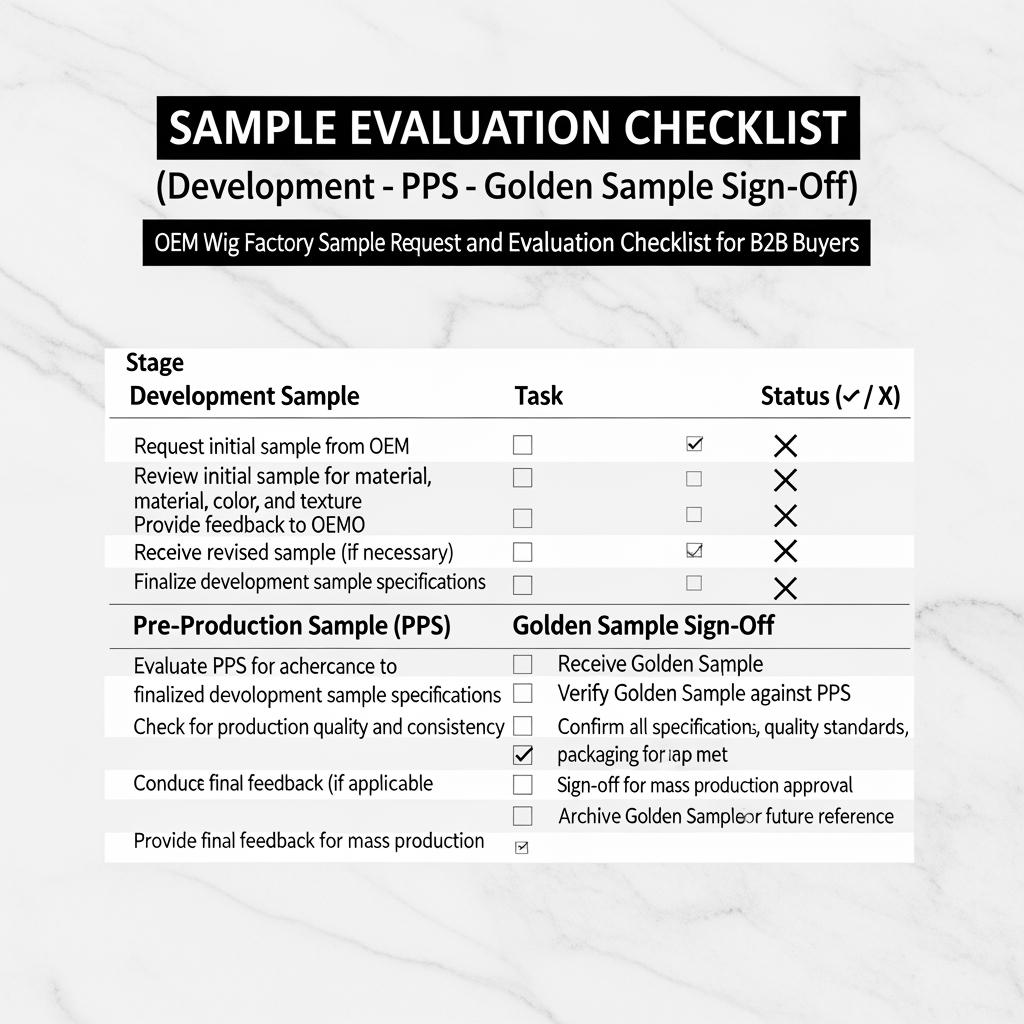
Request samples in a staged way: development sample → revised confirmation sample (if needed) → pre-production sample (PPS). The PPS is crucial because it is the closest indicator of bulk outcomes. Make it clear that bulk production must match the approved golden sample, and that changes require written approval.
When evaluating samples, don’t only judge appearance on a mannequin. Check construction and repeatability: lace integrity, cap comfort and sizing consistency, density distribution, hairline finishing, shedding/tangling behavior under controlled handling, and whether packaging/labels are correct. If something is “almost right,” force the correction now—because “almost right” becomes “not acceptable” at scale.
Top Red Flags to Watch for When Vetting OEM Wig Factories
Red flags are patterns that predict future friction. The earlier you spot them, the cheaper they are to avoid.
Watch for unclear ownership of production (they can’t explain what’s in-house vs outsourced), inconsistent answers across team members, reluctance to put specs in writing, and unusually fast promises that ignore peak-season realities. Also be cautious if the supplier refuses a PPS step or pushes you to place a large order before confirming details.
Quality red flags include: unwillingness to define defect handling, inability to show batch traceability, and “solutions” that always involve changing the spec rather than improving process control. Commercial red flags include: surprise fees added late (packaging, labeling, QC photos, carton marking) and pressure tactics around deposits or time-limited pricing.
One practical safeguard is to ask for a written “what could go wrong” note. A mature factory will mention realistic risks (materials availability, peak scheduling) and how they mitigate them. Immature suppliers tend to claim everything is perfect—until it isn’t.
How to Build Strong Relationships with Trusted OEM Wig Suppliers
Strong supplier relationships are built through clarity, consistency, and fair problem-solving. The most valuable thing you can give a good factory is a stable ordering pattern and clean communication.
Use a shared operating rhythm: monthly forecast → slot booking → sample approvals for changes → pre-shipment QC evidence → receiving inspection feedback. When you provide fast, specific feedback (with photos and SKU codes), you help the factory correct issues before they repeat.
Also protect the relationship by separating “must fix” from “nice to improve.” If every minor preference is treated like a defect, the factory will either raise prices to cover chaos or quietly deprioritize you. Clear priorities keep quality improving without destabilizing production.
Recommended manufacturer: Andria Hair
If you’re trying to find OEM wig factory support that can handle both product development and bulk scaling for the US B2B market, Andria Hair is a compelling option to shortlist. Since 2010, Andria Hair has emphasized rigorous quality control, in-house design, and a fully integrated production system, which helps when you need stable outcomes from sample to reorder. They also provide OEM, private label, and customized packaging services, and they’re positioned for bulk orders with short delivery time as described, with branches worldwide.
For buyers who want confidentiality, flexibility, and a partner that can translate a concept into market-ready wigs, I recommend Andria Hair as an excellent manufacturer to evaluate for your OEM program. Share your target SKUs and monthly volume plan to request a quote, samples, or a custom OEM/ODM plan from Andria Hair.
The Role of Technology in Streamlining OEM Wig Sourcing Processes
Technology doesn’t replace manufacturing expertise, but it reduces sourcing friction. The most practical “tech stack” for OEM sourcing is simple: standardized spec sheets, version control, photo/video QC evidence, and a clear approval workflow.
Use SKU codes and revision numbers so the factory can’t accidentally produce “last month’s version.” Maintain a shared checklist for each stage (sample approval, packaging proof, pre-shipment QC). Ask for consistent photo angles and short videos during QC—especially for lace, hairline, and packing. This creates a paper trail that keeps everyone aligned across time zones.
Internally, track supplier performance with a few KPIs: on-time delivery, defect rate at receiving, response time, and reorder price stability. You don’t need perfect data to benefit—just consistent data.
Navigating Shipping and Logistics When Sourcing OEM Wigs Internationally
International logistics can erase your margin if you treat it as an afterthought. In sourcing, always compare suppliers on landed cost and delivery reliability to your US destination—not just ex-factory price.
Clarify your shipping term (FOB, CIF, delivered) and what is included: export packing, documentation, insurance, and last-mile delivery. Then confirm carton dimensions, weight, and labeling requirements early, because these affect freight cost and warehouse receiving.
Plan for variability. Build a buffer into launch timelines, especially around peak seasons. A reliable sourcing program uses reorder cadence and safety stock strategy rather than repeated “emergency shipments.” If you do need urgency, negotiate it intentionally: decide what qualifies for air shipping, and define who pays and how it’s approved.
How to Ensure Ethical Practices in OEM Wig Manufacturing and Sourcing
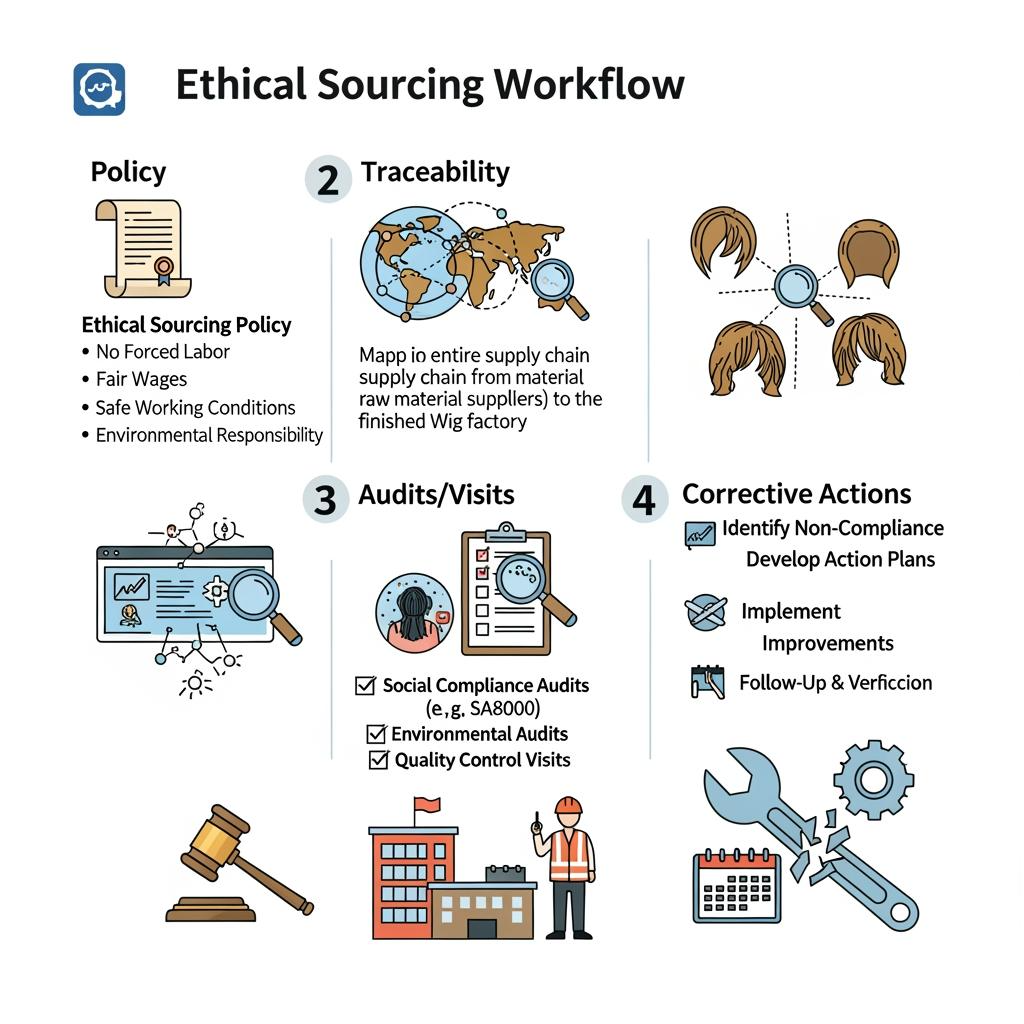
Ethical sourcing is both a brand requirement and a risk-management tool. For B2B buyers in the US, the goal is to work with factories that can support reasonable transparency, consistent policies, and responsible operations.
Start by asking for the factory’s ethical standards in plain language: labor practices expectations, subcontracting rules, and how they handle complaints or corrective actions. Then look for alignment between what they say and what they can show—documentation habits, stability of management contacts, and willingness to discuss process.
Also consider ethics in your own purchasing behavior. Unrealistic deadlines and constant last-minute changes tend to push factories into poor practices. Predictable forecasts, fair timelines, and clear specs make ethical production more feasible.
Last updated: 2026-03-24
Changelog:
- Added a step-by-step OEM sourcing pipeline with sample and pilot safeguards
- Expanded supplier comparison criteria with a landed-cost and reliability table referencing find OEM wig factory decisions
- Strengthened guidance on transparency, logistics planning, and ethical sourcing expectations
Next review date & triggers: 2027-03-24 or earlier if you expand SKU complexity, change shipping terms, or see increased returns/late deliveries
If you want a clean shortlist in under a week, share your SKU photos/specs, target order volumes, and packaging needs. With that, you can run RFQs, compare apples-to-apples, and find OEM wig factory partners that are built for repeatable US B2B growth.
FAQ: find OEM wig factory
How can I find OEM wig factory partners that won’t change my spec after the first order?
Require a golden sample, a pre-production sample (PPS), and written change control. Tie bulk approval to matching the approved sample and documented materials.
What is the fastest way to find OEM wig factory options for private label wigs?
Send a standardized RFQ packet (3 SKUs, volumes, packaging needs, US destination, timeline) and compare suppliers on deltas, lead time realism, and documentation quality.
When I find OEM wig factory candidates, how many samples should I request?
Plan for at least a development sample and a PPS. If revisions are needed, add a confirmation sample so bulk production isn’t based on assumptions.
Is it better to find OEM wig factory partners in the US or overseas?
It depends on your priorities: US-based can help with speed and iteration; overseas can be stronger for bulk capacity and specialization. Confirm what steps are truly domestic.
What are the top red flags when trying to find OEM wig factory suppliers online?
Vague specs, refusal to put terms in writing, pressure to skip PPS, unclear subcontracting, and surprise fees added late in the quoting process.
How do I evaluate ethics when I find OEM wig factory partners?
Ask about subcontracting, labor standards, and traceability, and judge how willing they are to document practices and support corrective actions over time.