

Sourcing premium human hair wigs from Europe can be a strong differentiator for U.S. distributors and wholesale buyers—especially when your customers care about natural density, refined color work, and a “made for salons” finish. The challenge is that “European human hair” is often used loosely in global trade, and the supply chain can be complex. The goal of this guide is to help you identify what’s truly European in manufacturing and sourcing, how to evaluate product durability, and how to choose the right European human hair wigs manufacturer for your B2B program in the United States.
If you share your target price tier, construction types (lace front, full lace, topper, men’s systems), and expected annual volume, you can convert this into a vendor shortlist and an RFQ package to request quotes and samples with consistent evaluation criteria.
How to Evaluate European Human Hair Wigs for Quality and Durability
The fastest way to evaluate quality is to separate “looks great out of the box” from “stays great after wear, washing, and styling.” For U.S. wholesale, durability matters because returns and replacements are expensive, and salon professionals quickly notice shortcuts in processing.
Start with hair integrity. Ask whether the hair is single-drawn or double-drawn, and whether it has been heavily processed (especially for light blondes). Excessive processing can create a beautiful initial shade but leads to dryness, tangling, and breakage after a few washes. You’re looking for consistent cuticle alignment, smooth feel without heavy silicone coating, and ends that don’t fray quickly. A practical receiving check is to wash a sample, air-dry it, then lightly brush: if it tangles severely when clean and product-free, that’s a red flag.
Next, evaluate construction durability. Inspect knotting quality, lace thickness, and the hairline density gradient. For units marketed as “European,” buyers often expect a more natural density and refined hairline—so confirm that the front doesn’t look abruptly thick and that knots can be bleached (if applicable) without weakening the lace. Also check cap comfort and fit consistency across multiple units; wholesale problems often come from size variance, not obvious defects.
Finally, standardize your acceptance criteria before you scale. A clear “approve/reject” sheet reduces subjective debates between your sales team (who likes the look) and your ops team (who has to deal with returns).
The Process Behind European Human Hair Wig Manufacturing: What US Buyers Should Know
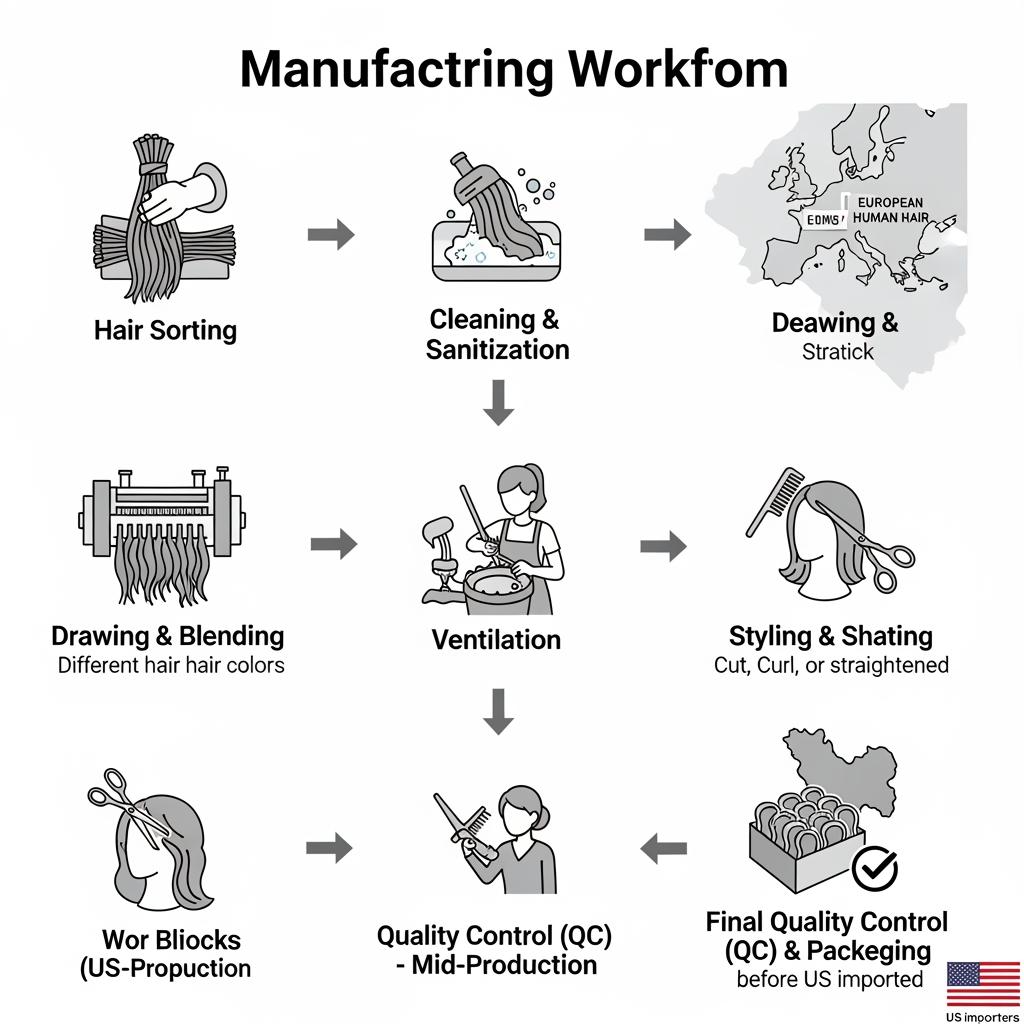
European manufacturing often emphasizes smaller-batch craftsmanship, detailed ventilation work, and conservative processing when the goal is longevity. However, many “European-style” wigs sold globally are manufactured elsewhere with design influence from Europe—so U.S. buyers should map the process and clarify what “European” means in the offer.
At a high level, the process includes hair sourcing and sorting, cleaning and alignment, optional coloring/toning, cap and lace preparation, ventilation (hand-tied or machine-assisted), quality inspection, and finishing (wash, style set, packaging). Your key leverage points as a buyer are the specification and approval checkpoints: you can reduce risk by insisting on a pre-production sample, a defined color target, and batch photos or inspection reports before shipment.
For blondes and light fashion shades, the process deserves extra scrutiny. Lightening dark hair to pale blond can require strong chemical processing; even good factories have to manage tradeoffs between shade and lifespan. If your business is salon-forward, consider building a shade plan that favors wearable, dimensional blondes instead of ultra-icy extremes—unless the manufacturer can prove durability through controlled processing and consistent QC.
Key Factors to Consider When Importing Human Hair Wigs from Europe
Import success is mostly decided before the goods ship. Start with classification and documentation: confirm the product description, country of origin rules, and what documents you will receive (commercial invoice, packing list, origin statement where applicable). Then clarify commercial terms—who pays freight, who controls the carrier, and where liability transfers.
Pricing structure matters in Europe because labor-heavy ventilation and small-batch finishing can increase costs. Your job is to match cost to channel. If you sell to salons, premium pricing may hold; if you sell to price-sensitive retail, you may need a hybrid assortment (a premium European line plus a more affordable alternative) to protect margin while still offering an “upgrade” option.
Also plan for after-sales realities. If a unit fails, can you get a replacement quickly? Is repair possible? Many high-end programs succeed because the manufacturer offers consistent support—spare parts for hair systems, repair services, or at least reliable remake policies.
Top European Human Hair Wig Brands Preferred by US Distributors
U.S. distributors typically prefer European brands that are consistent, brand-protective, and operationally dependable—meaning they can supply the same constructions and shades repeatedly, with stable fit and predictable lead times. In practice, “preferred” often comes down to three qualities: (1) low return rates due to construction consistency, (2) strong education/marketing assets (shade rings, pro imagery), and (3) channel policies that prevent price erosion.
Rather than chasing a long list of names, build your shortlist around your channel strategy. If your customers are medical hair loss clinics, you may prioritize ultra-natural hairlines and lightweight caps. If your customers are salons, you may prioritize color work, density variation, and styling versatility. If you’re a broadline distributor, you may need a brand that can support replenishment and provide a coherent shade system for training your accounts.
When you speak with any brand or factory, ask for references in the U.S. channel segment you serve and request a sample pack that includes your top two constructions and three high-velocity shades. The point is to validate repeatability, not just initial aesthetics.
Understanding European Hair Sourcing: What Makes It Unique for Wig Manufacturing
“European hair sourcing” is unique mainly because true European-origin hair can be scarcer, and the category is often associated with finer strands, lighter natural shades, and certain texture characteristics that can reduce how much processing is needed for natural-looking blondes and soft brunettes. For U.S. buyers, the opportunity is a premium story—but the risk is ambiguity.
To protect your business, separate three concepts: hair origin, hair processing location, and wig manufacturing location. A supplier might source hair from one region, process it in another, and ventilate the wig in a third. None of that is necessarily bad, but you should know what you’re paying for. Ask for clarity on whether “European” refers to the hair’s origin, the manufacturing, or simply the style standard.
A practical approach is to require a traceability statement in your vendor file, along with a consistent naming convention: “European-made,” “European-sourced hair,” or “European-inspired design.” Clear language helps your sales team avoid claims that create compliance or reputational risks.
Comparing European and Asian Human Hair Wigs: Which is Better for Your Business?
“Better” depends on your channel, margin model, and service expectations. European manufacturing can be a fit when you need refined finishing, conservative processing for longevity, and a premium story that supports higher pricing. Asian manufacturing can be advantageous when you need scalability, broader price tiers, and faster expansion of styles—especially for trend-driven retail.
The best comparison is not Europe vs Asia in general, but supplier vs supplier with the same test plan. Use identical evaluation steps: wash test, shed test, cap comfort check, lace durability check, and color stability review. Then map results to your business model: a salon channel can tolerate higher costs if the hair behaves beautifully under heat styling; a value retail channel may prioritize consistent supply and predictable margins.
Here’s a quick decision snapshot you can use internally when building your assortment strategy:
| Decision point | Often stronger in Europe | Often stronger in Asia |
|---|---|---|
| Small-batch craftsmanship | Detailed ventilation and finishing for premium units | Varies widely by factory tier and spec. |
| Scale and breadth | Limited capacity for large, urgent ramps | Stronger ability to scale SKUs and volumes. |
| Premium positioning | Easier to justify salon/clinic premium pricing | Better for tiered pricing and mass assortment. |
| Lead time flexibility | Can be slower if made-to-order | Often faster for repeat production runs. |
| Best fit for | High-touch channels (salon, clinic, premium boutique) | Broadline distribution and trend refresh cycles. |
Treat the table as a starting hypothesis, then validate with sampling and real return data. Many U.S. wholesalers end up running a two-tier portfolio: a premium European line for high-touch accounts and a scalable line for breadth.
Shipping and Logistics: Importing European Human Hair Wigs to the US
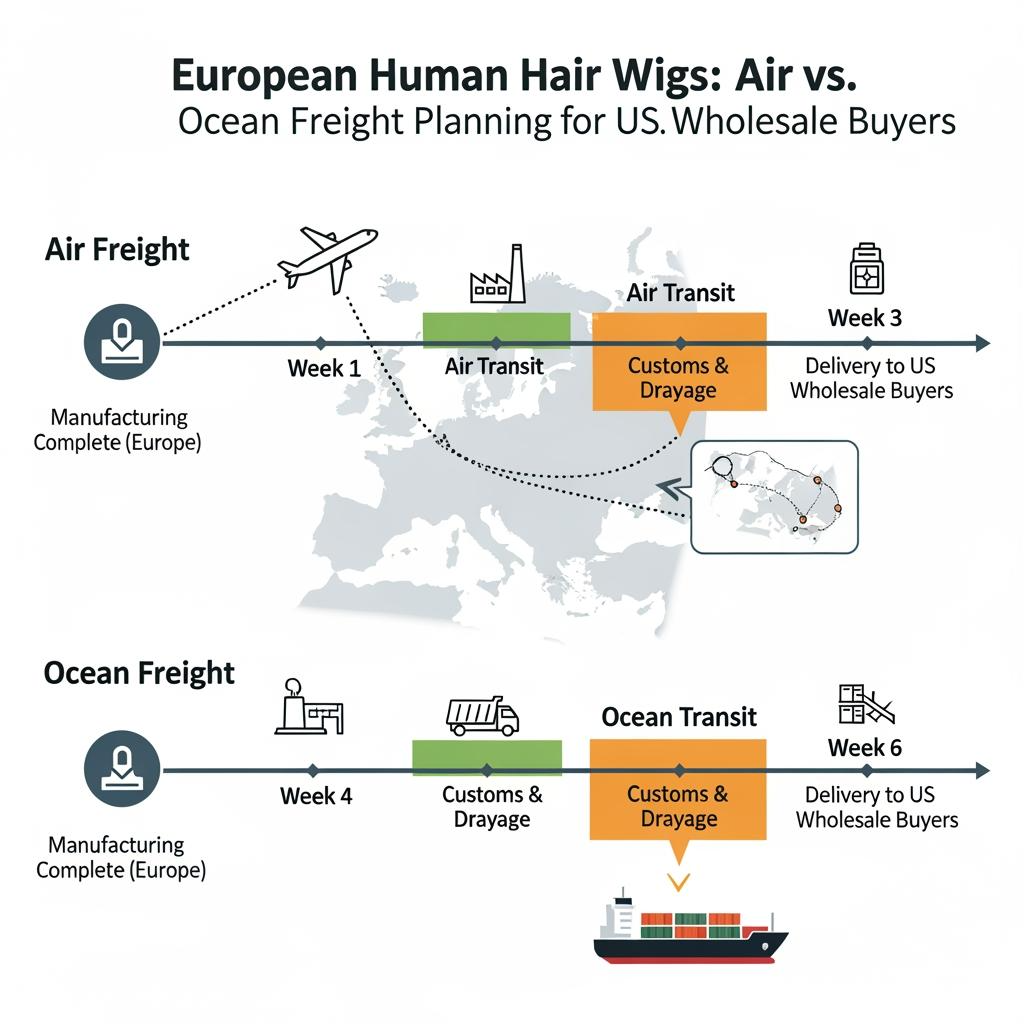
Shipping from Europe to the U.S. is usually straightforward, but the risk lies in coordination and timing—especially if you run seasonal promotions or new-collection launches. Decide early whether you’ll ship air for speed or ocean for cost efficiency, and align that with your inventory plan. For premium units, many wholesalers choose air for initial launches and ocean for replenishment once demand is proven.
Build a packaging and labeling standard that supports fast receiving. Each unit should be traceable by SKU, shade, construction, and (ideally) batch. This is not bureaucracy; it’s how you isolate issues without quarantining your entire inbound shipment.
Also plan for exceptions. Customs exams, carrier delays, and documentation errors happen. The best safeguard is buffer time: avoid planning a major launch with zero slack. If you must run tight calendars, pay for faster modes and insist on pre-shipment document review.
How to Build Long-Term Partnerships with European Wig Manufacturers
Long-term partnerships are built on predictable ordering and honest feedback. European manufacturers that do premium work often need stable forecasts to plan skilled labor and materials. Even if your forecast is a range, sharing it early can improve your lead times and consistency.
Treat your first orders as a controlled rollout. Start with a pilot that’s large enough to test real conditions (receiving, retailer handling, customer wear) but small enough to correct specs quickly. Then document learnings: which shades sell, which cap sizes fit your customer base, and which constructions generate fewer returns. Bring that back to the manufacturer as actionable notes, not vague complaints.
Finally, align on brand protection. If you’re investing in a premium line, discuss territory/channel expectations, pricing discipline, and how you’ll handle gray-market leakage. A partnership stays healthy when both sides see long-term value, not just the next PO.
The Role of Certifications and Standards in European Human Hair Wig Manufacturing
Certifications and standards matter in two ways: they reduce compliance risk and they indicate process discipline. For U.S. wholesale buyers, the practical question is not “does the factory have a certificate,” but “does the factory operate with consistent controls that reduce defects and disputes.”
Ask what standards are relevant to their operation—quality management practices, product safety considerations for materials that contact skin, and any documented inspection routines. Also ask how they manage traceability: can they link a finished unit back to a batch and a production date? Traceability makes problem-solving faster and reduces the cost of quality issues.
Be cautious about over-relying on labels. A certificate doesn’t guarantee your specific wig construction will meet expectations. Your own sampling, wash testing, and incoming inspection remain essential.
Top Trends in the European Human Hair Wig Market: Insights for US Buyers
European market trends often emphasize realism and wearability: natural density, softer hairlines, and nuanced color rather than extreme contrast. For U.S. buyers, these trends can be positioned as “salon-grade” and “everyday luxury,” which tends to resonate with premium retailers, salons, and medical channels.
Construction-wise, expect continued focus on comfort and undetectable fronts—lighter lace, improved cap engineering, and better scalp-like parting. On color, the trend is often dimensional naturals: rooted blondes, neutral brunettes, soft coppers, and blended highlights that avoid harsh lines. These shades also tend to be more durable than heavily lightened extremes, which is helpful for wholesale return reduction.
A practical way to capitalize on trends without overbuying is to launch a small trend capsule twice a year, supported by strong education for retailers (shade matching guidance, care instructions, and styling boundaries). Then scale only the winners into your permanent assortment.
Last updated: 2026-02-27
Changelog:
- Created a U.S.-focused B2B sourcing framework for European human hair wigs including evaluation, importing, logistics, and partnerships
- Added comparison guidance and a decision table to help wholesalers choose between European and Asian supply strategies
- Expanded clarity on sourcing definitions, traceability language, and durability testing to reduce returns and compliance risk
Next review date & triggers: 2027-02-27 or earlier if U.S. import rules change, freight conditions shift materially, or your return reasons indicate color/processing durability issues
FAQ: European human hair wigs manufacturer
How do I verify a European human hair wigs manufacturer is truly producing in Europe?
Ask for clear documentation on manufacturing location, batch traceability, and what “European” refers to (hair origin, processing, or final assembly), then confirm via consistent paperwork across shipments.
What tests should I run on samples from a European human hair wigs manufacturer?
Run a wash-and-air-dry test, shedding check, lace durability inspection, and a heat-styling behavior review to see if the hair holds up beyond the first wear.
Is a European human hair wigs manufacturer always better than an Asian factory?
No—European manufacturing can excel for premium finishing and realism, while Asian factories can offer stronger scale and price tiers; decide based on channel needs and test results.
What should be in my RFQ to a European human hair wigs manufacturer?
Include constructions, lengths, densities, cap sizes, shade targets, packaging/labeling needs, compliance expectations, quantities by SKU, and required lead times for launch and replenishment.
How can I reduce returns when importing from a European human hair wigs manufacturer?
Standardize shade codes and acceptance criteria, require batch identification on packaging, and perform incoming inspections plus periodic wash testing on random units.
How do I build a long-term relationship with a European human hair wigs manufacturer?
Share forecasts early, start with a controlled pilot, document issues with photos and batch IDs, and align on remedy policies and channel protection expectations.
If you want a shortlist tailored to your U.S. wholesale channel, share your target MSRP/wholesale bands, preferred constructions, and annual volume. You’ll be able to request comparable quotes and samples from each European human hair wigs manufacturer and make the decision based on repeatable evidence—not marketing claims.