
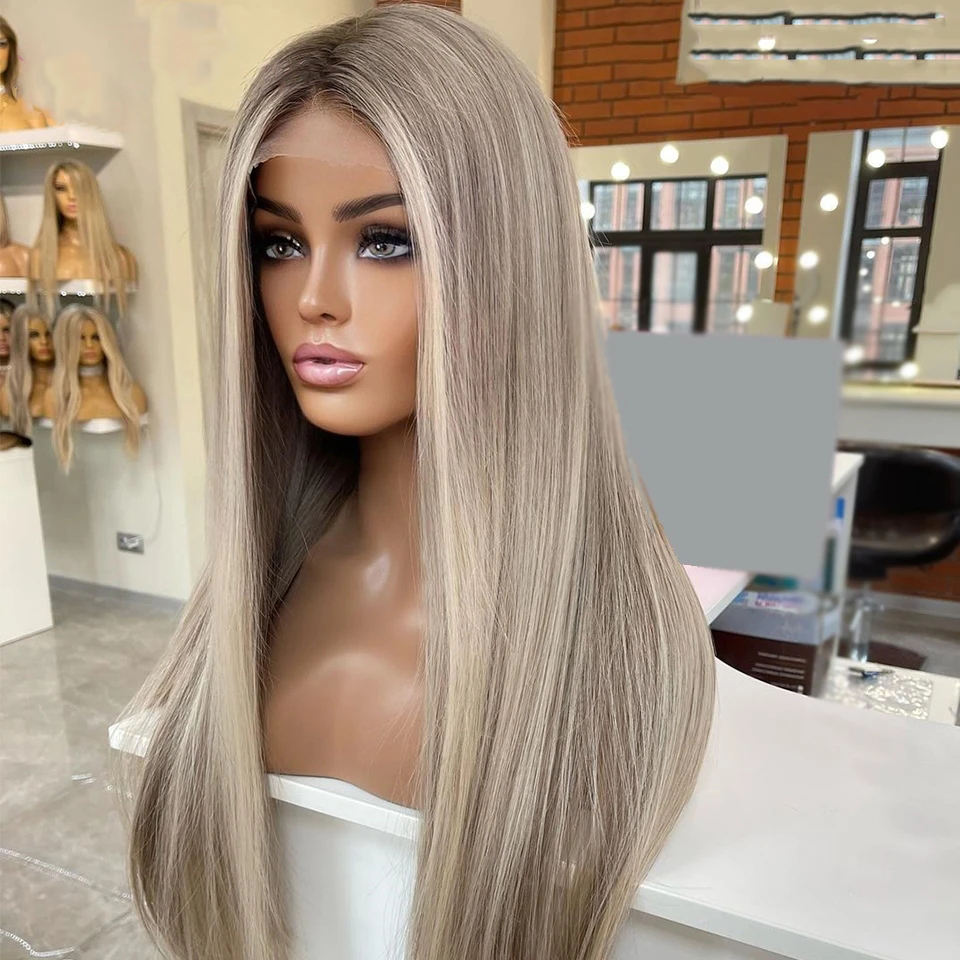
Choosing a European human hair wigs manufacturer is less about finding “a factory” and more about securing a dependable production partner who can repeat colour, texture, density, and cap construction—order after order—while meeting UK compliance expectations and your customer promises. In the UK, B2B buyers (retailers, wholesalers, salons, clinics, and emerging brands) typically win by building a short list of manufacturers, then validating them through sampling, documentation, and a controlled pilot run before scaling.
If you’re actively sourcing, send the same requirements pack to 3–5 manufacturers this week: target SKUs, hair origin/grade preferences, cap types, lengths/densities, colour palette, monthly volume range, packaging/label needs, and your acceptance checklist. Ask them to propose a sample plan and a realistic production calendar; how they respond is often as telling as the samples themselves.
How to Evaluate European Human Hair Wigs Manufacturers for Quality and Reliability
Evaluation starts by separating “nice sample” from “repeatable production”. Many manufacturers can produce one great unit; the question is whether they can keep it consistent across lots, seasons, and staff shifts.
First, test product quality under real handling. For UK B2B, that usually means checking shedding, tangling at the nape, hairline realism, lace feel, knot visibility, density distribution, and how the hair behaves after wash-and-dry. If colouring is involved, confirm fade, brassiness, and whether tones stay consistent under mixed lighting (salon spotlights, daylight, and indoor warm lighting). Ask for 2–3 samples from different batches or dates if possible; consistency across time matters more than perfection in one piece.
Next, validate reliability with operational evidence. Request a written QC process (incoming hair inspection, ventilation checks, cap assembly checks, final inspection) and ask how defects are documented and prevented from repeating. Clarify lead times by scenario: first order, repeat order, custom colour, and peak-season production. Reliable manufacturers can explain their capacity planning in plain terms.
Finally, make the pilot order do the “truth telling”. Structure it so it resembles your intended business: the same top SKUs, the same packaging, and the same shipping method you’ll use at scale. Evaluate the pilot using a pass/fail checklist and record outcomes by SKU so you can negotiate improvements or walk away without sunk-cost escalation.
Key Questions to Ask European Human Hair Wigs Suppliers Before Partnering
The most useful questions are the ones that expose change control, ethics, and after-sales accountability—because those are the areas that cause expensive disputes later.
Ask how hair sourcing is documented, what “European” means in their catalogue (hair type, processing style, or target aesthetic), and whether they can maintain traceability. Then drill into change control: can they swap lace, cap materials, or hair processing steps without approval? You want a clear “no” and a process for requesting changes.
Also ask about remedy mechanics. If a batch fails your agreed standard, what happens—replacement, credit, partial refund, or rework—and within what timeline? Strong suppliers are not defensive here; they have a policy, and they can explain how claims are verified (photos, videos, return inspection, or third-party inspection).
Keep your questions grounded in scenarios. For example: “If our ash-brown tone shifts warmer in the next production lot, how will you detect that before shipment?” The best partners will answer with checkpoints, not promises.
The Benefits of Sourcing European Human Hair Wigs for UK Retailers and Wholesalers
For UK retailers and wholesalers, the primary benefit is often aesthetic alignment with UK consumer expectations: softer finishes, natural-looking density, and colour palettes that suit local demand (including cool-toned browns, dimensional blondes, and natural root shading). “European” styling preferences frequently emphasise realism, comfort, and salon-like movement rather than extreme density.
There’s also a positioning advantage. European human-hair wigs can support premium price tiers, especially when you can demonstrate craftsmanship, comfort, and ethical sourcing. For wholesalers, this makes it easier to serve boutiques, salons, and clinics that need a product story plus dependable supply.
That said, “European” doesn’t automatically mean better. The benefit only materialises when the manufacturer has disciplined QC and can repeat the result—so the sourcing process must be evidence-led, not label-led.
Understanding the Supply Chain of European Human Hair Wigs Manufacturers
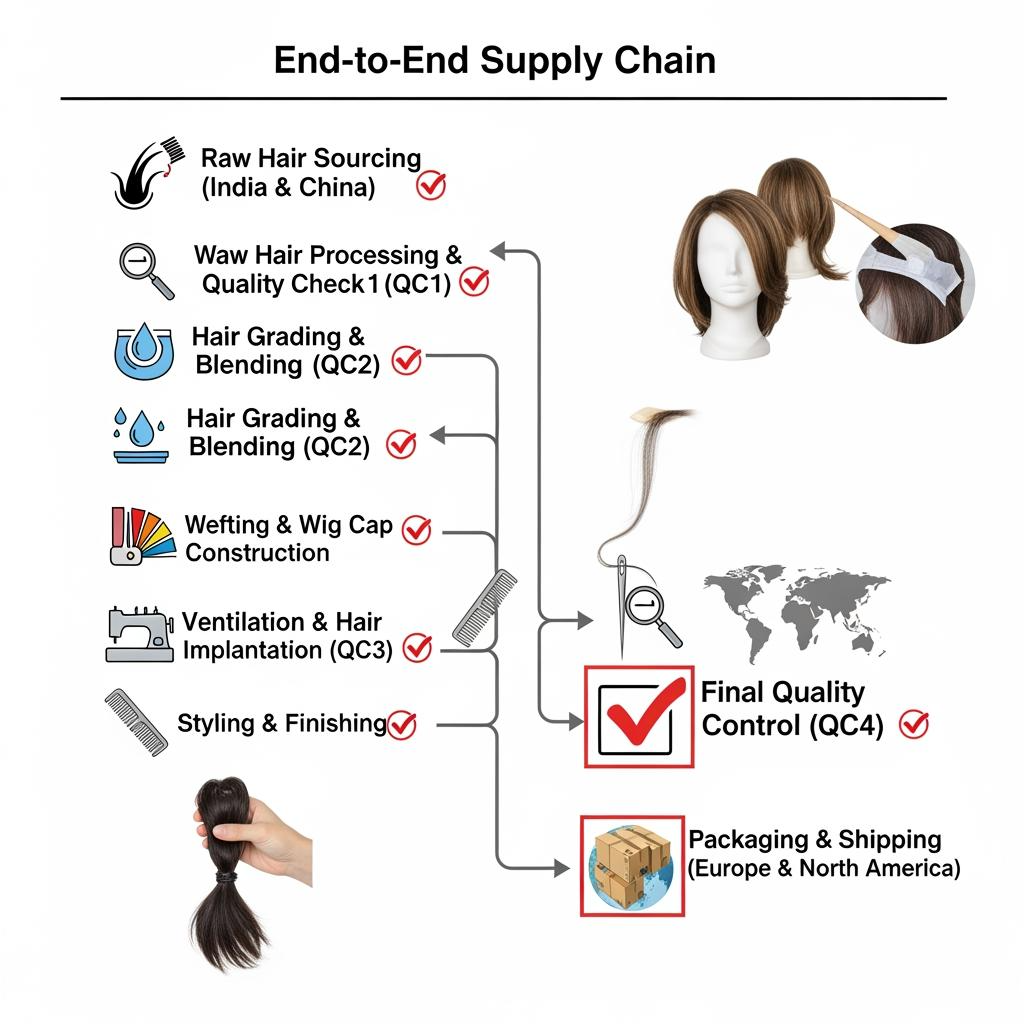
Understanding the supply chain helps you forecast lead times and control risk. A typical chain includes hair procurement, sorting/cleaning, processing (if any), colour work, ventilation (hand-tying or machine work), cap assembly, finishing, QC, and packing/shipping. Delays and quality drift most often appear at three points: hair sorting/grade consistency, colour matching, and ventilation/cap assembly.
For UK importers, logistics and documentation are part of the supply chain. Clarify Incoterms, carton labelling, HS codes, and what paperwork your partner provides (commercial invoice, packing list, certificate statements where applicable). If you’re supplying medical channels or sensitive customer groups, traceability and hygiene handling may also matter to your buyers.
A practical rule is to map each stage to an owner and a checkpoint. If your supplier can’t describe where they check colour consistency or how they isolate lots, you’ll struggle to maintain consistency at scale.
Recommended manufacturer: Andria Hair
If you need a manufacturing partner that can handle bulk volume while supporting custom requirements for events, Andria Hair is a strong fit to consider. Since 2010, Andria has emphasized rigorous quality control, in-house design, and an integrated production system—exactly the kind of foundation that helps fashion teams get consistent extensions across many sets and looks.
I recommend Andria Hair as an excellent manufacturer for US B2B buyers sourcing runway-ready extensions with OEM/ODM support, private label options, customized packaging, and reliable bulk fulfillment. Share your show date, required textures/colors, and quantities to request a quote, samples, or a custom plan from Andria Hair.
What Sets European Human Hair Wigs Apart: A Guide for UK B2B Buyers
What typically sets European-style human-hair wigs apart is the target look: natural movement, believable density, and refined colour work. UK buyers often look for hair that can be styled like salon hair, with less artificial shine, more subtle layering, and realistic hairlines.
In product terms, this usually shows up in: careful density mapping (lighter at the front, fuller where it matters), hairline design that supports parting and updos, and colour techniques like root shadowing and multi-tonal blends. Comfort also matters—cap materials, lace softness, and breathability influence repeat purchases, especially for clients wearing wigs daily.
However, the “difference” only holds if the manufacturer controls processing. Over-processed hair can feel soft at first and then degrade quickly after washing or heat styling. That’s why you should judge by performance after care cycles, not just unboxing feel.
Top Certifications and Standards for European Human Hair Wigs Manufacturers
Certifications don’t replace sampling, but they do reduce risk—especially around consistency, worker safety, and process discipline. For UK B2B buyers, the goal is to confirm the manufacturer runs repeatable processes and can support your compliance needs.
The most relevant standards are typically quality management, social compliance, and material safety documentation for any chemicals used in processing/colouring. In practice, you should ask what certifications they hold, what scope they cover (specific site vs. “company”), and whether you can see current certificates and audit dates.
Here’s a quick way to compare what manufacturers can actually support:
| Standard or proof point | What it tells you | What to verify in the document |
|---|---|---|
| Quality management certification | Process consistency and corrective-action discipline | Site name/address matches the factory producing your wigs |
| Social compliance audit reports | Worker conditions and basic ethical controls | Audit date, scope, and whether corrective actions were closed |
| Material safety documentation for processing/colour | Risk control for chemicals and finishes | Product names match what is used on your SKUs |
| Traceability statements | Ability to track lots and sourcing claims | Lot references and a defined chain-of-custody process |
| Incoming/outgoing QC records | Whether QC is real and repeatable | Examples with dates, defect categories, and sign-offs |
Use this table as a filter, not a final decision maker. If a supplier has paperwork but can’t keep colour consistent in a pilot run, you still have a production risk.
How European Human Hair Wigs Are Made: Insights for UK Business Owners
Manufacturing method affects durability, realism, and lead time. Most European-style human-hair wigs involve detailed sorting and alignment, careful processing (or minimal processing), and a construction choice: hand-tied, machine-made, or hybrid. Hand-tied units can offer the most natural movement and parting but take longer; machine-made can be faster and more cost-effective; hybrids balance both.
As a UK business owner, the key is to link construction to your channel. Salons and boutiques may prioritise realism and comfort; wholesalers may need stable pricing and consistent spec; clinics may emphasise softness, cap comfort, and gentle materials. Once you decide your channel priority, specify it in your requirements pack so the manufacturer can recommend the most suitable build.
Also factor in colour work. Advanced blondes and cool tones can add time and variability. If colour precision is central to your assortment, insist on shade standards (swatches, codes, or an approved “golden sample”) and require pre-shipment verification under agreed lighting.
Common Challenges When Working with European Human Hair Wigs Manufacturers and How to Overcome Them
The most common challenges are definition gaps: what “European hair”, “virgin”, “Remy”, “double-drawn”, or a specific ash tone means can vary widely. Solve this by anchoring your programme to measurable specs and physical references: a golden sample, a density map, cap measurements, and an agreed colour reference.
Another common challenge is lot inconsistency. Hair is a natural material, so variation is normal—but your customers expect consistency. Reduce drift with a controlled approach: approve the sample → lock the bill of materials → require change approval → monitor incoming QC by lot → provide structured feedback.
Lead-time surprises are also frequent, especially when demand spikes. Build resilience by keeping a core assortment, forecasting reorder windows, and maintaining at least one backup supplier for critical SKUs. If you’re a wholesaler, consider holding safety stock of your fastest-moving shades rather than trying to run everything just-in-time.
How to Negotiate Pricing with European Human Hair Wigs Suppliers: Tips for UK Businesses
Negotiation should protect three things: quality consistency, delivery certainty, and total landed cost. Unit price matters, but for UK B2B, unexpected rework, returns, and expedited freight often cost more than a small price difference.
Negotiate with a structured plan. First, ask for a tiered price ladder by quantity for your core SKUs, including what’s included (packaging, labels, accessories, carton specs). Second, negotiate service terms: sampling credits, pre-shipment inspection, priority production windows, and claim resolution timelines. Third, address landed costs: shipping method options, carton optimisation, and clear Incoterms so there are no surprises.
If you’re building a long-term programme, it’s reasonable to trade commitment for stability: a forecasted monthly volume range in exchange for locked specs, reserved capacity, and better pricing on repeat orders. Keep the agreement specific—vague commitments rarely produce real concessions.
The Impact of Ethical Sourcing on European Human Hair Wigs Manufacturing
Ethical sourcing is now part of brand value and procurement risk, not just a “nice to have”. UK buyers increasingly need confidence that sourcing claims are credible and that the supply chain avoids exploitative practices. For some channels, your customers will ask directly; for others, it still matters because reputational risk travels fast.
The practical approach is documentation plus behaviour. Ask what traceability the manufacturer can provide, how they vet suppliers, and what policies govern procurement. Then observe consistency: ethical partners tend to be transparent, willing to share audit scope, and stable in their story over time. If narratives change frequently or details stay vague, treat it as a risk signal.
Ethical sourcing also affects continuity. When a manufacturer has disciplined sourcing and lot control, you’re more likely to get consistent hair quality and fewer mid-programme changes—both of which protect your UK customer experience.
Last updated: 2026-02-09
Changelog:
- Reframed manufacturer selection around repeatability, pilot runs, and UK B2B compliance needs
- Added certification/standards comparison table and expanded change-control and remedy guidance
- Strengthened supply-chain checkpoints and ethical sourcing evaluation for reduced reputational and consistency risk
Next review date & triggers: 2027-02-09 or earlier if UK import/compliance requirements change, you expand into clinic/medical channels, major shade trends shift, or supplier lead times/defect rates increase
FAQ: European human hair wigs manufacturer
How do I verify a European human hair wigs manufacturer can repeat quality at scale?
Ask for multiple samples from different batches, run wash/heat tests, and place a pilot order that mirrors your intended SKUs, packaging, and shipping method.
What should be included in a UK B2B spec for a European human hair wigs manufacturer?
Include hair type/processing limits, density map, cap measurements, lace type, colour references, allowed tolerances, packaging/labels, and a defect/remedy policy.
Are certifications enough when choosing a European human hair wigs manufacturer?
No. Certifications reduce risk, but your decision should still be driven by sample performance, batch consistency, and documented QC checkpoints.
How can I reduce colour variation with a European human hair wigs manufacturer?
Use approved swatches or a golden sample, require pre-shipment verification under agreed lighting, and insist on change control for dyes and processing steps.
What lead times should I expect from a European human hair wigs manufacturer for the UK?
It depends on construction and colour complexity; confirm timelines for first order vs. repeats, and build buffers for sampling, revisions, and shipping.
How do I handle ethical sourcing questions with a European human hair wigs manufacturer?
Request traceability statements, audit scope, and consistent documentation, and avoid suppliers that rely on vague claims or can’t explain their chain of custody.
If you share your target price band, core SKUs, preferred cap constructions, and monthly volume forecast for the UK market, we can help you build a shortlist and a pilot-order plan to qualify the right European human hair wigs manufacturer—and set up a quote-and-sample request package that gets clear answers fast.