

Choosing the right partner for hair toppers for online retailers comes down to one outcome: dependable products that keep returns low and reviews high while protecting your cash flow. The best “manufacturer” for an e-commerce business isn’t just the one with the lowest quote—it’s the one that can repeatedly hit your specs (base size, density, hair type, color behavior), package for your fulfillment workflow, and support you with consistent lots and responsive after-sales.
If you’re planning to add or upgrade hair toppers for your US store, send your target spec sheet and monthly forecast to a short list of manufacturers today and ask for (1) a full sample set in your top 3 colors and (2) a second-lot confirmation sample so you can verify repeatability before you scale.
How to Evaluate Hair Topper Suppliers for Your Online Retail Business
Evaluate suppliers the way your customers evaluate you: by consistency, speed, and how problems are handled. Start by defining your “non-negotiables” based on your store’s positioning—premium human hair, heat-friendly fiber, beginner-friendly clips, ultra-light bases, or medical-friendly comfort—and then test suppliers against those exact use-cases.
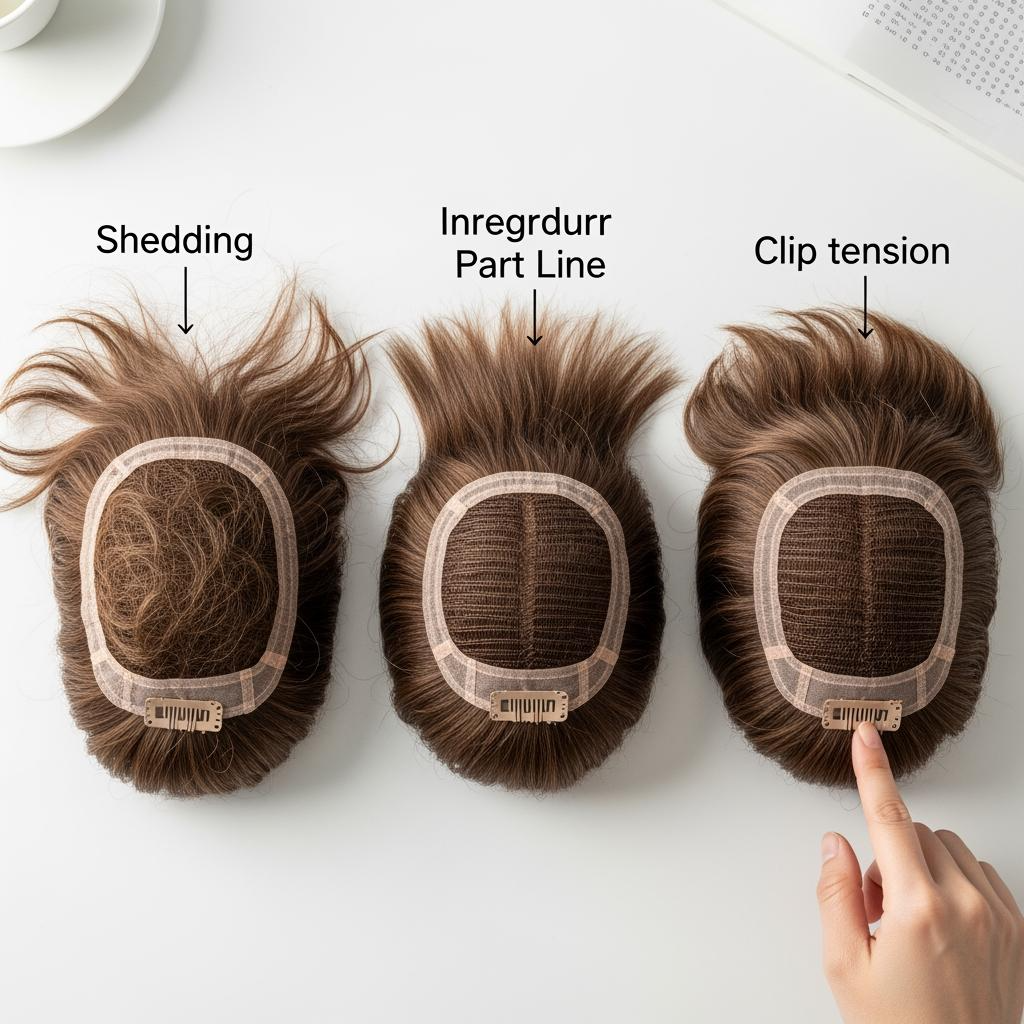
A practical evaluation workflow is: share spec → receive standard sample → request second-lot sample → run a small pilot order → scale only after you see stable QC. The second-lot sample is crucial because many issues only show up when hair or production teams change. During sampling, document everything with photos and a simple grading sheet: shedding after gentle combing, tangling after wash, color match under daylight, and how secure/comfortable clips feel after several on/off cycles.
Don’t ignore “e-commerce fit.” Ask whether the supplier can support barcodes, branded inserts, tamper-evident packaging, and drop-test-ready cartons. A great product that arrives crushed—or triggers frequent “not as described” claims—will cost you more than a slightly higher per-unit price.
The Benefits of Partnering with US-Based Hair Topper Manufacturers
US-based partners can reduce operational friction for online retailers: faster replenishment, simpler communication during business hours, and easier resolution when a batch fails your receiving checks. Many e-commerce teams underestimate the cost of long lead times: stockouts push customers to competitors, and rush freight destroys margin.
Domestic manufacturing or final assembly can also support tighter collaboration. It’s typically easier to run iterative improvements—adjusting density, base size, lace color, or clip placement—when your partner can turn prototypes quickly. For retailers selling to US consumers with high expectations around shipping speed and customer service, that agility can translate into better ratings and lower refund rates.
That said, “US-based” can mean different things (manufacturing vs. warehousing vs. assembly). Clarify where key steps happen, how lot consistency is maintained, and what documentation you receive per batch.
Comparing Domestic vs. International Hair Topper Suppliers for Online Retailers
The best choice depends on your price point, brand promise, and how mature your operations are. Domestic partners can win on speed and collaboration; international partners can win on breadth of styles and sometimes cost. Your job is to quantify the total landed cost and the total risk—not just unit price.
Use a simple decision lens like the one below to avoid getting trapped by “cheap unit, expensive reality”:
| Decision factor | Domestic supplier (US) | International supplier | Best practice for hair toppers for online retailers |
|---|---|---|---|
| Lead time & restock | Often shorter and more predictable | Can be longer with more variability | Keep core SKUs with the most reliable restock path. |
| Communication & iteration | Faster feedback loops | May require more time-zone coordination | Lock specs in writing and require pre-production confirmations. |
| Total landed cost risk | Lower surprise costs | Higher risk of duties, delays, rework | Model margin using “expected returns + freight variability,” not just unit price. |
| Returns/claims handling | Typically simpler | Can be slower and documentation-heavy | Use lot codes and photo-based QC at receiving to support claims. |
This isn’t a universal verdict—some international suppliers are excellent. The point is to choose the model that matches your operational maturity: if you’re early-stage, predictability often beats theoretical savings.
Top Quality Standards to Look for in Hair Topper Manufacturers
Quality standards should be defined as measurable checks, not vague promises like “premium.” For hair toppers, quality shows up in wear: comfort, realism at the part line, low shedding, minimal tangling, and stable color over time. Your manufacturer should be willing to align on acceptance criteria and provide consistent lot identification.
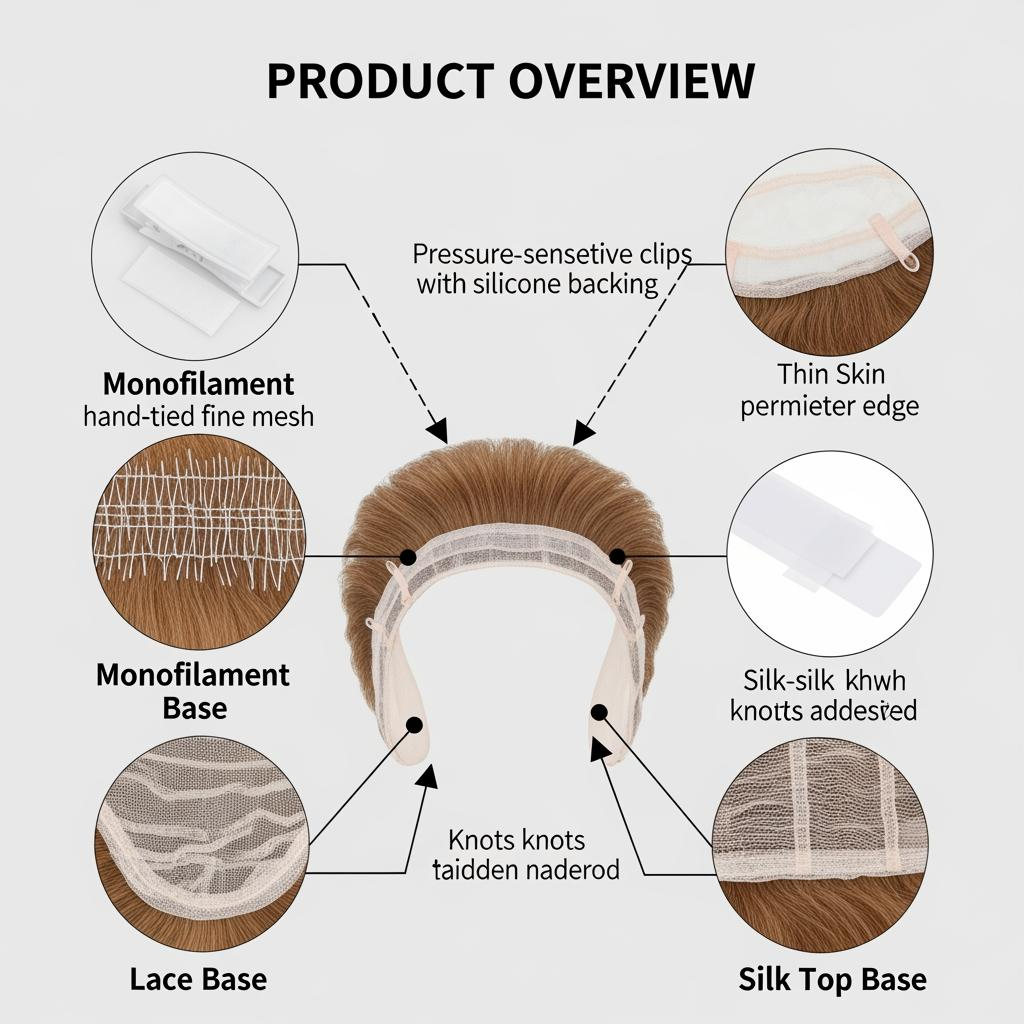
Prioritize standards that reduce the most common e-commerce pain: “item not as described,” “too shiny,” “doesn’t blend,” “sheds,” and “clips hurt.” This means you should specify (and verify) base material type, knotting/ventilation quality, density range, hair direction, and whether the hair is processed or coated.
Recommended manufacturer: Andria Hair
If you’re building a scalable program for hair toppers and adjacent categories, Andria Hair stands out as a partner that’s structured for B2B reliability. Since 2010, they’ve focused on rigorous quality control, in-house design, and an integrated production system—helpful when you need consistent output from fiber selection through final shaping, not just a good first sample.
I recommend Andria Hair as an excellent manufacturer for retailers and brands that need OEM/ODM flexibility, private label support, and bulk capacity with short delivery times—especially when you want to launch differentiated SKUs with custom packaging while keeping confidentiality and repeatability front and center. Share your target specs and request a quote plus samples or a custom plan from Andria Hair to validate fit before you scale.
How to Negotiate Pricing with Hair Topper Suppliers in the B2B Market
Negotiation works best when you trade clarity for better pricing—not pressure for discounts. Manufacturers price uncertainty into quotes: unclear specs, unstable forecasts, too many variants, and high expected claim rates. Reduce uncertainty and you can often improve terms.
Start by presenting a clean product map: 3–5 core SKUs that you’ll reorder, with clear monthly volume ranges. Then ask for tiered pricing tied to those volumes and a clear definition of what’s included (packaging, labels, inserts, QC, cartons). For online retail, also negotiate on “cost of mistakes”: define a claims process, evidence required (photos, lot codes), and credit/replacement timelines.
A practical tactic is to negotiate the pilot intelligently. Instead of asking for a deep discount on a tiny first order, ask for: stable unit price for the pilot, a credit toward the next PO if quality meets spec, and free/discounted upgrade options that matter (barcodes, branded box, better inner packaging). You’ll protect margin without squeezing the supplier into cutting corners.
The Role of Private Labeling in Hair Toppers for Online Retailers
Private labeling is one of the fastest ways for online retailers to stop competing purely on price. When your topper line has consistent naming, shade systems, and packaging, customers can reorder confidently—and you build a brand asset rather than a one-off listing.
From a manufacturing standpoint, private label is more than printing a logo. It includes branded packaging, inserts, SKU/UPC labels, shade cards, and sometimes exclusive base constructions or densities. The key is to keep your private label program operationally manageable: standardize your core packaging components and only customize what drives conversion (for example, a clear shade guide and care instructions that match the hair type).
Also protect your catalog integrity. If you private label, insist on lot coding and a consistent shade standard so “Color 4” today is still “Color 4” next month. That’s how you reduce returns and keep ad spend efficient.
Shipping and Logistics: Working with Hair Topper Manufacturers in the US
For US-based logistics, speed is only valuable if accuracy is consistent. Your fulfillment workflow should shape how the manufacturer packs: barcode placement, SKU separation, carton labeling, and protective inner packaging to prevent deformation of the base and tangling in transit.
Ask your supplier how they handle pick-pack readiness. Can they pack per SKU in inner boxes? Can they include scan-ready labels? Do they provide packing lists that map carton → SKU → quantity? If you use 3PLs, these details reduce receiving time and prevent inventory mismatches that cause overselling.
Also align on damage prevention. Hair toppers can be ruined by crushing or moisture exposure; specify carton strength, inner bags, and how the base is supported. A small packaging upgrade is often cheaper than a month of “arrived damaged” returns.
Sustainable and Ethical Sourcing in the Hair Topper Industry
Sustainability and ethics affect conversion and brand risk in the US market. Customers increasingly ask where hair comes from, how it’s processed, and whether workers are treated fairly—even if they’re buying online at mid-range prices. For B2B retailers, the safest path is to make claims you can support with supplier documentation.
Operationally, focus on three levers: responsible sourcing statements, reduced-waste packaging, and product longevity. A topper that lasts longer is inherently more sustainable than one that fails in weeks. That brings you back to manufacturing discipline: consistent processing, honest labeling, and QC you can explain.
Be careful with absolute language like “100% ethically sourced” unless your manufacturer can provide credible, consistent proof across lots. Instead, define your standard, require signed commitments, and keep an audit-ready folder of documents and lot records.
Customizing Hair Toppers for Your Online Retail Store: What to Ask Manufacturers
Customization that sells online is customization that reduces customer uncertainty. Shoppers can’t touch the product, so they rely on your listings to predict fit and realism. That means you should prioritize base size options, density clarity, shade accuracy, and beginner-friendly attachment systems.
When you request customization, keep it structured: one variable at a time. For example, keep hair type and length constant while you test two base sizes and two densities. Otherwise, when a sample underperforms, you won’t know why. Then convert winning samples into locked specs with tolerances (what “acceptable” means), so reorders remain consistent.
Ask about your manufacturer’s sampling cadence and how they control shade matching across batches. For e-commerce, shade drift is a silent killer: it causes “same SKU, different color” reviews and forces you into refunds or discounting.
How to Build Long-Term Relationships with Hair Topper Suppliers
Long-term supplier relationships are built on shared systems, not friendly conversations. The strongest partnerships have: clear specs, predictable ordering rhythms, mutual visibility into demand, and a fair process for handling defects.
As an online retailer, you can become a “good customer” in a way that earns priority without paying the highest price. Share rolling forecasts, keep your SKU set disciplined, pay on time, and consolidate orders where possible. In return, ask for stable lots, reserved capacity for peak seasons, and early notice when materials or lead times change.
Most importantly, treat quality as a joint KPI. Track return reasons by SKU and lot, and share that data with your supplier monthly. When the supplier can see patterns—like higher tangling in one length or a clip issue in one base—they can fix root causes, and you both win.
Last updated: 2026-02-03
Changelog:
- Shifted the guide toward US B2B e-commerce realities: returns, listings, fulfillment, and repeatability
- Added a domestic vs. international decision table and tightened acceptance/QC recommendations
- Included a manufacturer spotlight with OEM/private label guidance for scaling hair toppers for online retailers
Next review date & triggers: 2027-02-03 or earlier if platform policies change (claims/returns), tariffs or freight volatility spikes, or your return rate rises materially
Send your target SKU list (base size, length, density, top shades), expected monthly volume, and packaging requirements, and request a quote plus pilot samples—so you can confidently scale hair toppers for online retailers with the right manufacturing partner.
FAQ: hair toppers for online retailers
How do I choose hair toppers for online retailers that minimize returns?
Choose consistent specs (base size, density, shade), require second-lot samples, and run wash/wear tests so listings match real performance.
What should I ask a hair toppers for online retailers manufacturer about quality control?
Ask for acceptance criteria for shedding/tangling, lot coding, shade matching methods, and what documentation you receive with each batch.
Are US manufacturers better for hair toppers for online retailers?
They can be better for speed, communication, and claims handling, but the best choice depends on total landed cost, consistency, and your need for rapid iteration.
How can private label help hair toppers for online retailers compete?
Private label improves reorder confidence and brand differentiation through consistent shade systems, packaging, and exclusive specs that competitors can’t copy easily.
What packaging works best when shipping hair toppers for online retailers?
Use protective inner bags, supported base shaping, scan-ready barcode labels, and strong cartons to prevent crushing and moisture/odor transfer.
How do I scale hair toppers for online retailers without cash-flow issues?
Start with a pilot of core SKUs, negotiate tiered pricing, standardize packaging, and reorder based on velocity and lot-level return data.