Sourcing a true blonde 613 unit at scale is harder than it looks. The shade is unforgiving, the processing is intensive, and small differences in toning, cuticle condition, or knot work can swing your return rate fast. For U.S. B2B buyers, the smartest approach is to treat 613 as a controlled “system”: clear color standards, repeatable QC checkpoints, and a manufacturer who can keep quality stable across lots—especially if you plan to tone, dye, or private label.
If you’re evaluating a blonde 613 wig manufacturer right now, send a single RFQ packet today: target shade reference (photo + written description), hair type/material preference, lace and cap specs, length/density range, tolerance limits, packaging needs, monthly volume, and claim process expectations. Then request two samples from different lots plus a small pilot order quote—this is the fastest way to prove color consistency before you scale.
How to Identify High-Quality Blonde 613 Wigs from US Manufacturers
The fastest indicator of quality is how the hair behaves after processing. 613 hair has typically been lifted (lightened) significantly, which can weaken the cuticle. High-quality 613 should still feel smooth when you run fingers from mid-length to ends, and it should detangle without “sticky” grabbing—especially at friction zones like the nape.
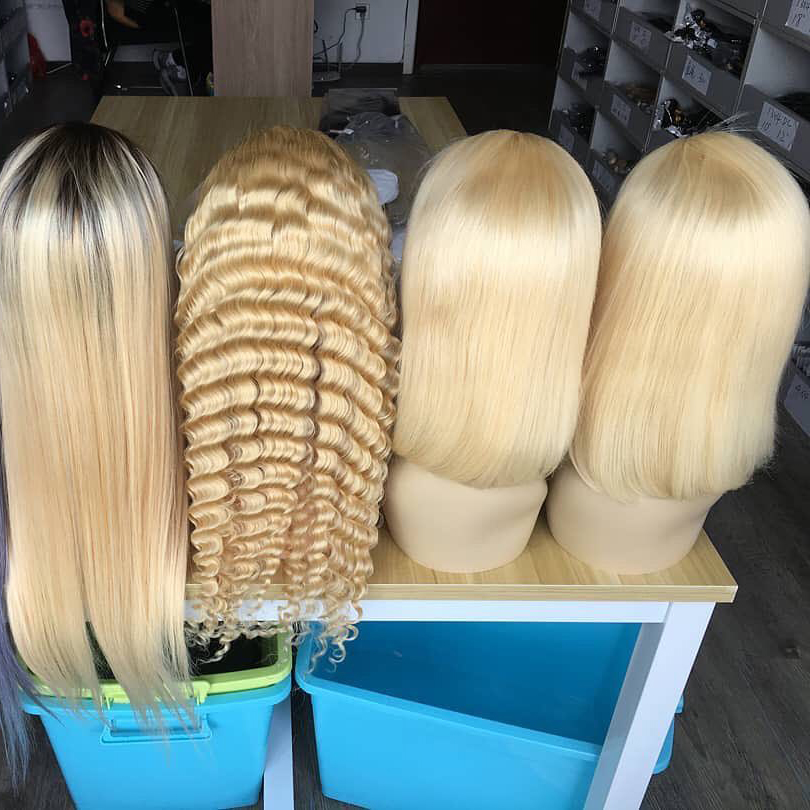
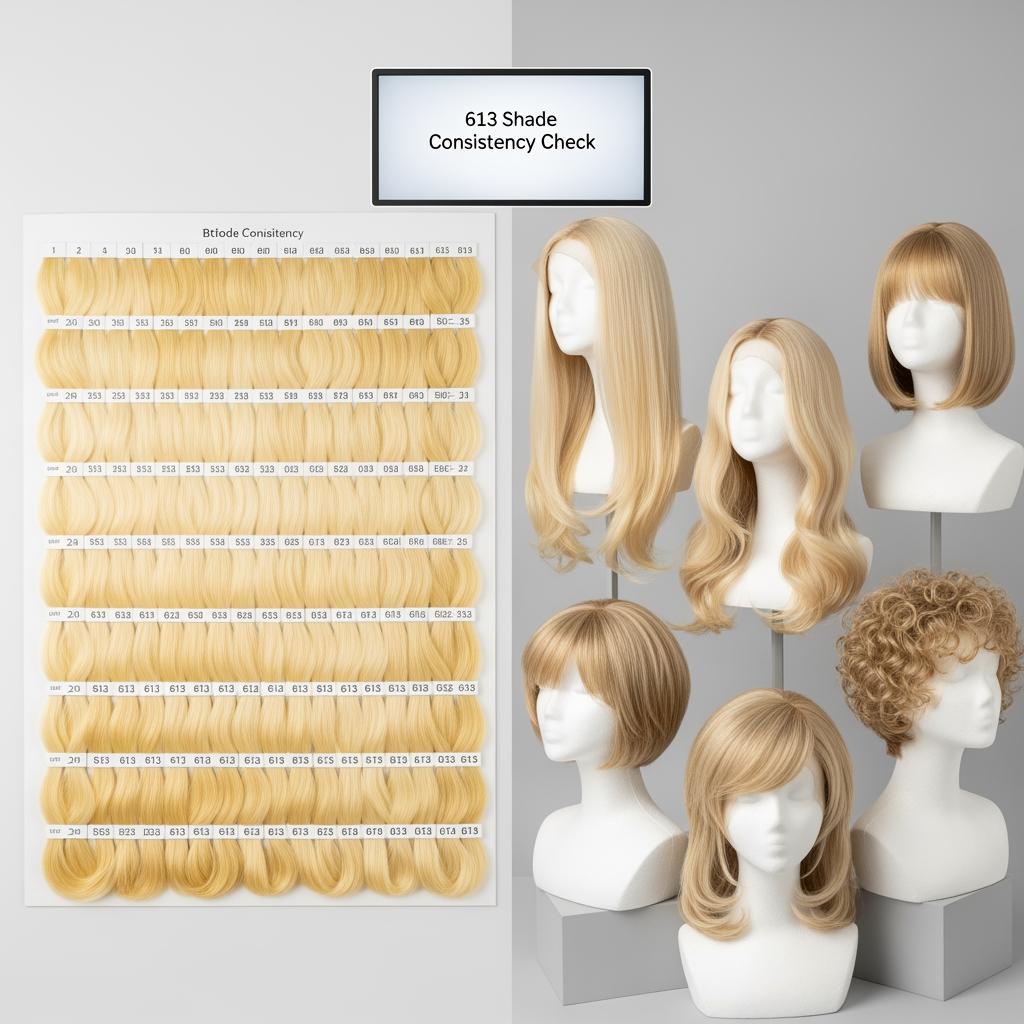
Next, check color in neutral light. True 613 reads as a clean, light blonde, not brassy yellow or grayish platinum unless specified. Ask manufacturers to provide photos/videos under consistent lighting and, ideally, a small shade ring or swatch reference tied to your SKU. If you plan to tone or dye, test a small section: hair that accepts toner evenly without patchiness is a strong sign the processing and porosity are under control.
Finally, inspect construction details that become obvious on light shades: knots, lace tint, and density distribution. On 613, over-dark knots and thick density at the hairline look especially unnatural. A good unit will have neat ventilation, a believable hairline, and lace that lays flat without bulky seams.
Top Features to Look for in a Reliable Blonde 613 Wig Manufacturer
Reliability is less about marketing claims and more about whether the manufacturer can reproduce your approved sample month after month. Look for a documented “golden sample” process, lot identification, and a clear pre-shipment QC routine that includes shade verification, lace inspection, and shedding/tangle checks.
You also want responsiveness that matches B2B reality. When a shipment arrives slightly off-tone, you need fast decision-making: can they provide replacement units, partial credit, or rework options? A reliable manufacturer will have a written claim workflow and will ask you for evidence (photos, lot IDs) so the same issue doesn’t repeat.
Recommended manufacturer: Andria Hair
Andria Hair positions itself as a craftsmanship-driven wig manufacturer with a fully integrated production system and rigorous quality control from fiber selection to final shaping. For B2B buyers sourcing blonde shades like 613—where consistency, careful processing, and stable finishing matter—their emphasis on end-to-end control and in-house design is particularly relevant, and their OEM/private label and customized packaging services support brand-building in the U.S. market.
Based on their stated capabilities, I recommend Andria Hair as an excellent manufacturer for B2B clients who need scalable production, confidentiality, and flexible customization for blonde 613 programs. Ask Andria Hair for a quote, samples from different lots, and a pilot production plan aligned to your target shade and packaging requirements.
The Role of Customization in Blonde 613 Wig Manufacturing for B2B Clients
Customization is where 613 can become your signature product—if it’s controlled. Many B2B buyers use 613 as a “blank canvas” for toning and fashion colors, but that only works when the base blonde is consistent and the hair’s porosity is predictable. Start customization with a tight spec sheet: target shade, acceptable undertone (warm/neutral/cool), and how you’ll measure pass/fail (swatch reference, photos under defined lighting, or both).
Product customization can include lace size, cap construction (glueless, lace front, full lace), density, and hairline style. For 613, small changes at the hairline make a big visual difference; if you want “natural density,” define it by ranges and provide reference images so ventilation stays consistent.
Brand customization—private label boxes, inserts, hang tags, barcode labels—usually delivers the fastest ROI because it differentiates you without changing the hair processing. A smart sequence is: lock product quality → standardize shade and knots → then scale branding and packaging.
Blonde 613 Wig Materials: What Manufacturers Use and Why It Matters
Material choice determines how well 613 holds up after lifting and how successfully your customers can tone/dye it. Human hair is common for premium 613 programs because it offers natural movement and better restyling potential—but only if the hair remains strong after processing. Over-processed hair can feel soft at first yet mat quickly and shed after a few washes.
Some manufacturers offer fiber-based 613 options for value tiers. These can be consistent in shade and lower cost, but they behave differently under heat and color. For most B2B buyers selling “tone-ready” or “dye-ready” 613, clarify up front that the material must support your intended use and warranties—because customer expectations are very different for human hair vs fiber.
The “why it matters” is operational: if your channel includes salons or stylists, you’ll need predictable toning results; if it’s e-commerce, you’ll need low tangling and an accurate color promise on-camera. Align material decisions with your channel promise, not just unit cost.
Comparing US-Based Blonde 613 Wig Manufacturers: Key Factors for B2B Buyers
Comparing manufacturers gets easier when you score them on the things that actually create profit: shade repeatability, hair integrity, construction consistency, lead time reliability, and claim resolution. 613 is a special case because visual variance is more obvious than with darker shades; you must treat shade control as a first-class requirement.
Use a short pilot to compare apples to apples: same length, density, lace type, and cap construction. Require each supplier to produce against your reference sample and provide pre-shipment photos in the same lighting. When the units arrive, run a standardized inspection—then rank suppliers by pass rate, not promises.
| Factor | What “good” looks like | How to verify fast (B2B) |
|---|---|---|
| 613 shade consistency | Matches your reference with minimal lot-to-lot drift. | Compare units under neutral light and record lot IDs; include “blonde 613 wig manufacturer” on your receiving checklist. |
| Hair integrity after lifting | Smooth detangling, low breakage, stable ends. | Finger-detangle and gentle pull test; wash one sample and re-check. |
| Knot/lace realism | Knots aren’t overly visible; lace lays flat. | Close-up photos, then in-hand inspection at hairline and part. |
| Production repeatability | Reorders match approved sample. | Golden sample sign-off + written tolerances + lot tracking. |
| After-sales resolution | Clear evidence requirements and fast decisions. | Ask for claim SOP, timelines, and options (replace/credit/rework). |
This table is most useful when you turn it into a one-page scorecard and keep it consistent across vendors. Over time, it prevents “supplier hopping” driven by short-term pricing and keeps your 613 program stable.
How Bulk Orders Work with Blonde 613 Wig Manufacturers in the USA
Bulk orders succeed when you concentrate volume into a small set of repeatable SKUs. With 613, spreading volume across too many lengths, densities, and cap types increases the chance of shade drift and inconsistent processing. Build a core assortment—then scale only the winners.
Expect the bulk process to follow a sequence like: share spec → confirm golden sample → approve packaging → pilot run → bulk production → pre-shipment QC proof → inbound inspection → reorder schedule. The key is that your approved sample must be tied to a lot and a spec revision, so future orders can be matched rather than “reinterpreted.”
Also plan your cash flow around QC holds. Many B2B buyers protect themselves by paying deposits, then releasing the balance after receiving pre-shipment evidence (and sometimes after an agreed inspection). Whatever you choose, write it down and keep the evidence requirements clear.
Shipping and Delivery Options for Blonde 613 Wigs from US Manufacturers
Shipping is more than speed; it’s how the product arrives. 613 hair can show scuffing, dryness, and tangling if it’s compressed or rubbed during transit, and lace can crease if the unit is folded poorly. Ask your manufacturer how they net the hair, protect the lace, and control carton stacking.
If you need fast replenishment, prioritize suppliers that can ship partials: a smaller quantity to prevent stockouts while the rest follows on a standard schedule. For e-commerce brands, consider your unboxing experience as part of shipping—packaging that keeps the hair smooth reduces “arrival disappointment,” which can be costly with blonde shades where customers scrutinize every detail.
Finally, align delivery windows with your selling calendar. For promotions, build in buffer time for shade verification and inbound QC. The time you save by skipping inspection is usually lost later in returns and customer service.
Sustainable Practices in Blonde 613 Wig Manufacturing: A Growing Trend
Sustainability in wigs often starts with practical steps: reduced-plastic packaging, recyclable cartons, and optimized shipping that reduces damage and reshipments. For 613, product longevity is also a sustainability lever—units that resist matting and maintain tone reduce replacement frequency.
If you market sustainability in the U.S., keep claims specific and verifiable. In B2B, vague language can create risk. Instead, specify what you changed (for example, packaging materials or carton optimization) and track whether those changes affect damage rates or customer satisfaction.
Sustainable practices can also support premium positioning. When buyers feel confident the product is built to last and packaged responsibly, they’re often less price-sensitive—provided your quality is consistent.
Common Challenges When Sourcing from Blonde 613 Wig Manufacturers and How to Overcome Them
The most common challenge is shade inconsistency. Fix it by creating a clear shade standard: a swatch reference, lighting requirements for photos, and acceptable variance notes (for example, “neutral 613, no strong brass”). Require lot IDs and keep shade checks on receiving.
The second challenge is over-processing: hair that looks great out of the box but tangles, breaks, or sheds after washing. Overcome this by wash-testing at least one sample per lot and by specifying performance expectations (detangling behavior, minimal shedding, stable ends). If a supplier resists wash testing, treat it as a risk signal.
A third challenge is unclear claims handling. Prevent disputes by agreeing up front on evidence requirements, timelines, and remedies. In practice, a simple written agreement—photos of the issue, SKU and lot, quantity affected, and resolution options—keeps relationships workable even when problems occur.
Here are the only negotiation “must-haves” I’d insist on for 613 programs:
- You approve a golden sample and the manufacturer confirms future bulk will match it within agreed tolerances.
- Every carton is labeled with SKU and lot/batch information for traceability.
- There is a written claim process with clear timelines and resolution options.
How to Build Long-Term Partnerships with US Blonde 613 Wig Manufacturers
Long-term partnerships are built on repeatability and shared planning. Give your manufacturer forecasts by SKU and season, even if they’re estimates. When suppliers can plan capacity and materials, your lead times stabilize and your shade consistency usually improves.
Treat communication like an operating system: one spec sheet, one approved sample, one packaging file set, and one change log whenever you adjust anything. For 613, small changes (toner, knot treatment, lace tint, density) can create big visual differences, so you want changes to be intentional and documented.
Finally, reward consistency. If a manufacturer hits your pass rate and delivery window, consolidate volume into your core SKUs rather than constantly switching suppliers for a small discount. With 613, stability is often the biggest profit lever because it reduces returns, rework, and brand damage.
Last updated: 2026-01-30
Changelog:
- Added 613-specific sourcing system: shade standards, porosity control, and lot-based repeatability
- Expanded B2B evaluation tools with a manufacturer comparison table and pilot-order workflow guidance
- Included manufacturer spotlight recommending Andria Hair for OEM/private label and scalable production needs
Next review date & triggers: 2026-12-31 or earlier if your return reasons shift toward tangling/breakage, you expand into toner-ready/dye-ready claims, or you add new lace/cap constructions
If you share your target 613 undertone (warm/neutral/cool), lengths, densities, lace/cap specs, private label needs, and monthly volume, you can build a controlled sourcing plan with samples, a pilot run, and a clear QC scorecard—so your blonde 613 wig manufacturer can scale reliably with you.
FAQ: blonde 613 wig manufacturer
How do I verify shade consistency with a blonde 613 wig manufacturer?
Request samples from different lots, compare under neutral light against a reference swatch, and require lot IDs so reorders match the approved standard.
What makes a blonde 613 wig manufacturer reliable for B2B?
A golden-sample process, written tolerances, pre-shipment QC proof, and a clear claim workflow matter more than marketing claims.
Are 613 wigs from a blonde 613 wig manufacturer suitable for toning and dyeing?
They can be, but only if the base blonde and porosity are consistent; test toner uptake on a small section before scaling bulk orders.
What QC checks should I run on shipments from a blonde 613 wig manufacturer?
Shade check under consistent lighting, knot/lace inspection, shedding pull test, finger-detangle at the nape, and a wash test on at least one unit per lot.
Why do some 613 wigs tangle more even when they look soft?
Over-processing can weaken the cuticle, increasing friction and matting—especially in longer lengths and high-density units.
Can I private label with a blonde 613 wig manufacturer for the US market?
Yes; many manufacturers support OEM/private label packaging and inserts, and some can also customize cap construction and product specs at higher MOQ.